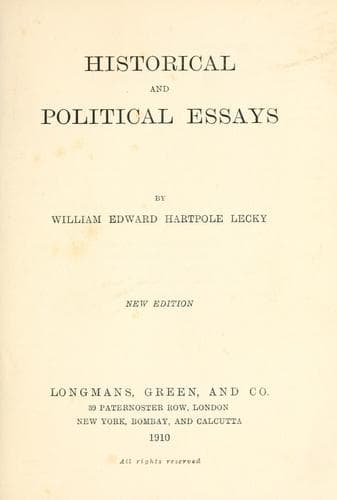
Historical and Political EssaysLecky, William Edward Hartpole
History
Historical and Political Essays
Lecky, William Edward Hartpole
History; Political science
Ireland thus found herself in possession of a Parliament which was, in
name at least, perfectly independent. It was a purely Protestant
Parliament, elected by Protestants, consisting mainly of landlords and
great Protestant lawyers, and representing pre-eminently the property
of the country. It was intensely and exclusively loyal, and always
ready to adopt far more stringent coercive measures against anarchy
and sedition than have ever been adopted by an Imperial Parliament. It
included many men of great talents and great liberality, and through
the county constituencies and the representatives of the chief towns
educated public opinion was seriously felt within its walls; but the
large majority of its members sat for nomination boroughs within the
control of the government, and places and pensions were inordinately
multiplied for the purpose of securing a majority.
Could this constitution last? In framing the course of foreign and
Imperial policy, in all questions of peace or war, of negotiations or
alliances, the Irish Parliament had no voice. Yet it might in time of
war, by withholding its concurrence, withdraw the whole weight of
Ireland from the forces and fatally dislocate the policy of the
Empire. It might pursue a commercial policy absolutely inconsistent
with Imperial interests, and bring Ireland into intimate commercial
connection with the enemies of England; and if English party spirit
extended to Ireland and ran in opposite directions in the two
legislatures, a collision was inevitable. The Lord Lieutenant and
Chief Secretary, who administered the government of Ireland, were
appointed by a British Ministry representing the dominant British
party; the counsels of the Irish Government were framed in a British
Cabinet; the royal consent was given to every Irish Bill under the
Great Seal of Great Britain and upon the advice of a British Minister.
If a machine so constituted could work as long as it was in the hands
of a small and undoubtedly loyal and largely influenced class, could
it work if Parliamentary reform made the Irish Parliament subject to
the fierce and fluctuating tides of popular opinion? above all, if
Catholic enfranchisement brought a vast, ignorant, and possibly
seditious element into political life?
Public-domain text, read in full here on John Shaqi.
Reviews
Reviews
No reviews yet
Be the first to share your thoughts on this work.
Join the Discussion
Join the discussion
Sign in to leave a comment or review.
Sign InorCreate an account