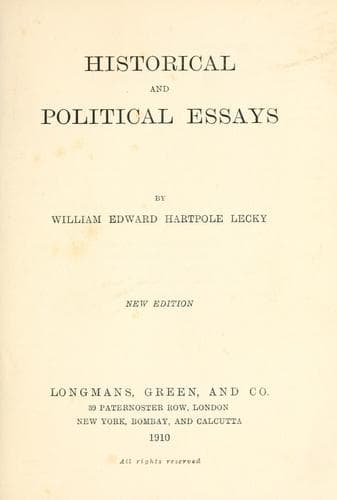
Historical and Political EssaysLecky, William Edward Hartpole
History
Historical and Political Essays
Lecky, William Edward Hartpole
History; Political science
It was the recorded opinion of each successive Lord Lieutenant who
administered the Irish Government after 1782 that it could not, and
that it must sooner or later end either in a union or a separation.
They said this, though they fully acknowledged the perfect loyalty
hitherto shown by the Irish Parliament; the liberality with which it
voted its supplies; the care with which it subordinated its particular
measures to the general interests of the Empire. The failure--not
solely or even mainly through Irish fault--of an attempt to establish
a fixed commercial arrangement between England and Ireland, and a
difference between the British and Irish Parliaments on the Imperial
question of a regency, strengthened the opinion of the English
Government, and for many years before the Union was enacted it was in
contemplation. On the two great and pressing questions at issue this
policy exercised a powerful influence. The Government obstinately
resisted every serious attempt to reform the Parliament, lest they
should lose that controlling power which they believed to be essential
to the permanence of the connection. On the Catholic question their
views were more fluctuating, but their dominant impression was that
emancipation could only be safely conceded in an Imperial Parliament,
and that it ought to be reserved as a boon which might one day make a
legislative Union acceptable to the Irish people.
In Ireland, or at least in Protestant Ireland, the idea of a Union was
now intensely unpopular, but the reformers in the Irish Parliament
were seriously divided. Flood and Charlemont desired Parliamentary
reform on a purely Protestant basis. They believed that this would
include in political life the bulk of the property, loyalty,
intelligence, and energy of the country, and that the Irish Catholics
could not for a long period be safely admitted to political power.
Grattan, on the other hand, believed that it was the first interest of
Ireland to efface the political distinction between the two creeds and
nations, and that an introduction of a certain proportion of Catholic
gentry into the Irish Parliament would be in the highest degree
beneficial. He, at the same time, always taught that Ireland was
utterly unfit for democracy, and that under her peculiar conditions no
policy could be more disastrous than one which would 'destroy the
influence of landed property'; 'set population adrift from the
influence of property'; subvert or weaken the guiding influence of the
loyal and educated. When the United Irishmen proposed a Reform Bill
which would have made the Irish Parliament a purely democratic body,
Grattan denounced it with the greatest vehemence. 'This plan of
personal representation,' he said, 'from a revolution of power, would
speedily lead to a revolution of property, and become a plan of
plunder as well as a scene of confusion.... Of such a representation
the first ordinance would be robbery, accompanied with the
Public-domain text, read in full here on John Shaqi.
Reviews
Reviews
No reviews yet
Be the first to share your thoughts on this work.
Join the Discussion
Join the discussion
Sign in to leave a comment or review.
Sign InorCreate an account