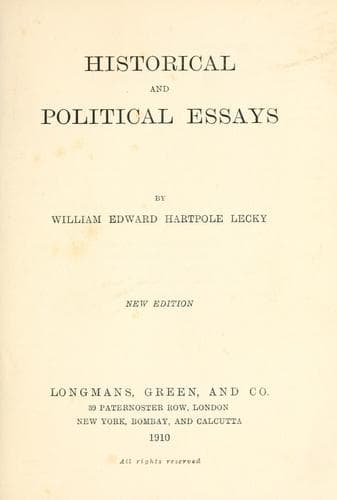
Historical and Political EssaysLecky, William Edward Hartpole
History
Historical and Political Essays
Lecky, William Edward Hartpole
History; Political science
The English Government thought that the time had now come for carrying
a legislative Union, and, in the eyes of Lord Cornwallis at least, one
of its chief recommendations was that it would take the government of
Ireland out of the hands of the triumphant party, and would make
Catholic emancipation a possibility. The Catholic bishops were sounded
and found to be very favourable. They declared their full willingness
to accept an endowment for the priesthood and to give the English
Government a right of veto on episcopal appointments, and they warmly,
efficiently, and unanimously supported the Union. The great majority
of the Catholic landed gentry and probably of the lower priests were
on the same side; but in general the Catholic laity seem to have
shown little interest and to have taken little part in the contest. In
Dublin, Catholics as well as Protestants were generally hostile, but
Catholic Cork was decidedly favourable, and an assurance that the
Government desired to carry emancipation in an Imperial Parliament
proved sufficient to prevent any serious Catholic opposition. The
United Irishmen seem to have witnessed rather with pleasure than the
reverse the dethronement of the body which had defeated them, and the
Presbyterians showed scarcely any interest in the question.
Yet outside the ranks of the Catholic clergy the measure found few
active supporters, while the Protestants of the Established Church
were in general ardently and passionately hostile. The great majority
of the county members and the great preponderance of petitions were
against the Union, and the opposition to it, which was led by Foster,
Grattan, Parsons, and Plunket, comprised nearly all the independent
and unbribed talent in Parliament. The very eminent ability of that
small group of Protestant gentlemen never flashed more brightly than
in the closing scenes, and there was a moment when the attitude of the
Orangemen and the yeomanry was so menacing that the Government were
seriously alarmed. But a lavish distribution of peerages and places
purchased a majority, and the troops stationed in Ireland were too
numerous for armed opposition to be possible. In truth, however, no
opposition beyond the dimensions of a riot was to be feared. Outside
Dublin, Catholic, Presbyterian, and seditious Ireland remained almost
indifferent. Even before the measure had passed, opposition speakers
complained bitterly that they were deserted by popular support; and it
is a memorable fact that in the general election that followed the
Union not a single Irish member of Parliament was defeated because he
had voted for it.
Public-domain text, read in full here on John Shaqi.
Reviews
Reviews
No reviews yet
Be the first to share your thoughts on this work.
Elsewhere in the archive
Join the Discussion
Join the discussion
Sign in to leave a comment or review.
Sign InorCreate an account