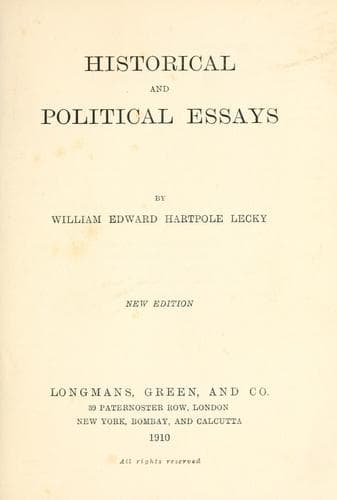
Historical and Political EssaysLecky, William Edward Hartpole
History
Historical and Political Essays
Lecky, William Edward Hartpole
History; Political science
circumstance incidental to robbery, murder.' He believed, however,
that with a substantial property qualification independent
constituencies might be formed which would safely represent the best
elements of both creeds.
The denial of parliamentary reform and Catholic emancipation, and the
refusal of the Irish Parliament to deal with the still more pressing
question of tithes, produced much disaffection; but still the country
was steadily improving, and no serious danger was felt till the French
Revolution burst upon Europe. In every country it stimulated the
smouldering elements of disorder. In few countries was its influence
more fatal than in Ireland. I have very lately described at length the
terrible years of growing conspiracy, anarchy, and crime; of
fluctuating policy, and savage repression, and revived religious
animosity, and maddening panic, deliberately and malignantly fomented,
that preceded and prepared the rebellion. It is sufficient here to say
that in the beginning of 1798 three provinces were organised to assist
a French invasion. But at the last moment the leaders were betrayed
and arrested; the French did not arrive; the rebellion was almost
confined to a few Leinster counties, and it broke out without leaders
and without a plan. In most places the rebels proved to be wretched
bands of marauders intent only on plunder, and, although they
committed many murders, they were utterly incapable of meeting the
loyalists in the field. But in Wexford, priests put themselves at the
head of the movement and turned it into a religious war, deriving its
main force from religious fanaticism, and waged with desperate courage
and ferocity. The massacre of Protestants on Vinegar Hill, in
Scullabogue Barn, and on Wexford Bridge, and the general character
the rebellion in Leinster assumed, at once and for ever checked all
that tendency to rebellion which had so long existed among the
Protestants of Ulster. Some twenty thousand persons perished before
the flame was extinguished. The repression was as savage as the
rebellion, and it left Ireland torn by fiercer religious animosities
than at any period since the Restoration.
It will dispel many illusions if the reader will remember that the
great Irish rebellion was directed mainly against the Irish
Parliament, and that it received its death-blow from Irish loyalists
acting under that Parliament before any assistance arrived from
England. The conspiracy began among Protestants and Deists, who aimed
at a union of sects for the purpose of obtaining a democratic
republic. It turned into a war which was scarcely less essentially
religious than the wars of the Cevennes or of the Anabaptists. Yet two
great Catholic provinces remained quiet during the struggle, and a
great proportion of the loyalist force which crushed the rebellion
consisted of Catholic militia.
Public-domain text, read in full here on John Shaqi.
Reviews
Reviews
No reviews yet
Be the first to share your thoughts on this work.
Elsewhere in the archive
Join the Discussion
Join the discussion
Sign in to leave a comment or review.
Sign InorCreate an account