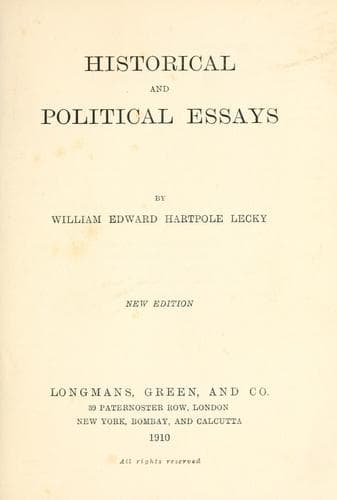
Historical and Political EssaysLecky, William Edward Hartpole
History
Historical and Political Essays
Lecky, William Edward Hartpole
History; Political science
The nature, methods, and objects of the organisation which would
probably exercise a dominant influence over an Irish Parliament have
been established by overwhelming evidence and beyond all reasonable
doubt, after a long, careful, and most impartial judicial
investigation. The report of the late Special Commissioners[7] and the
evidence on which it is founded have been published; and their
conclusions have very recently been summed up in an admirable work by
Professor Dicey, perhaps the ablest of living writers on political
subjects. Readers may find in these works abundant evidence of the
true character of the Irish Home Rule movement. If they read them with
impartiality they will, I believe, have little difficulty in
concluding that there have been few political movements in the
nineteenth century which are less deserving of the respect or support
of honest men.
FOOTNOTES:
[7] The Parnell Commission.--ED.
FORMATIVE INFLUENCES
It was about four years before the great upheaval of beliefs in
England, which was partly caused and partly disclosed by the
publication of the 'Essays and Reviews,' in 1860, that I entered
Trinity College, Dublin. I had then a strong leaning toward
theological studies and looked forward to a peaceful clerical life in
a family living near Cork; and in addition to the ordinary university
course, I went through that appointed for divinity students. I found
my life at the university one of more than common intellectual
activity, for although circumstances and temperament made me perhaps
culpably indifferent to college ambitions and competitions, I soon
threw myself with intense eagerness into a long course of private
reading, chiefly relating to the formation and history of opinions.
The great High Church wave which had a few years before been so
powerful, had been broken when Newman and many other leaders of the
party had passed to Catholicism. Darwin and Herbert Spencer had not
yet risen above the horizon. Mill was in the zenith of his fame and
influence. The intellectual atmosphere was much agitated by the recent
discoveries of geology, by their manifest bearing on the Mosaic
cosmogony and on the history of the Fall, and by the attempts of Hugh
Miller, Hitchcock, and other writers to reconcile them with the
received theology. In poetry, Tennyson and Longfellow reigned, I
think with an approach to equality which has not continued. In
politics, the school of orthodox political economy was almost
unchallenged. In spite of the protests of Carlyle, all sound Liberals
in England then desired to restrict as much as possible the functions
of government, and to enlarge as much as possible the sphere of
individual liberty; and they regarded unrestrained competition and
inviolable contracts as the chief conditions of material progress.
Public-domain text, read in full here on John Shaqi.
Reviews
Reviews
No reviews yet
Be the first to share your thoughts on this work.
Elsewhere in the archive
Join the Discussion
Join the discussion
Sign in to leave a comment or review.
Sign InorCreate an account