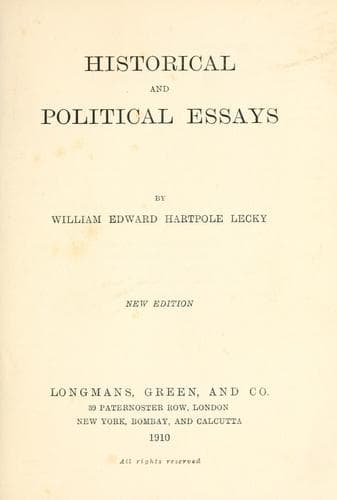
Historical and Political EssaysLecky, William Edward Hartpole
History
Historical and Political Essays
Lecky, William Edward Hartpole
History; Political science
The first great intellectual influence which I experienced was, I
believe, that of Bishop Butler, who was at that time probably studied
more assiduously at Dublin than in any other university in the
kingdom. There were few sermons in the college chapel in which some
allusion to his writings might not be found, and few serious students
whose modes of thought were not at least coloured by his influence.
That influence now appears to me to have been not only various, but
even in some measure contradictory. The 'Analogy' is perhaps the most
original, if not the most powerful, book ever written in defence of
the Christian creed; but it has probably been the parent of much
modern Agnosticism, for its method is to parallel every difficulty in
revealed religion by a corresponding difficulty in natural religion,
and to argue that the two must stand or fall together. Butler's
unrivalled sermons on human nature, on the other hand, have been
essentially conservative and constructive, and their influence has
been at least as strong on character as on belief. Their doctrine is
that consciousness reveals in the inner principles of our being a
moral hierarchy, 'a difference in nature and kind altogether distinct
from strength'; and that among these principles conscience has, by the
very structure of our nature, a recognised supremacy or guiding
authority which clearly distinguishes it from all others.
'The principle of reflection or conscience being compared with the
various appetites, affections, and passions in men, the former is
manifestly supreme and chief, without regard to strength.... From its
very nature it manifestly claims superiority over all others, so that
you cannot form a notion of this faculty, conscience, without taking
in judgment, direction, superintendency. To preside and govern, from
the very economy and constitution of man, belongs to it. Had it
strength as it has right, it would govern the world.'
It was a noble philosophy, well fitted to strengthen and elevate the
character, and it has supported many amid the dissolution of positive
beliefs. Utilitarian theories of morals move very smoothly as long as
their only task is to define the course which it is in the interests
of society that each man should pursue. They are less successful in
furnishing any firm and adequate reason why a man should pursue that
course when individual interests and individual passion are opposed to
it. It is the merit of the schools of Kant and of Butler, that they
raise the idea of duty above all the calculations of self-interest,
and make it the supreme and guiding principle of life.
Public-domain text, read in full here on John Shaqi.
Reviews
Reviews
No reviews yet
Be the first to share your thoughts on this work.
Elsewhere in the archive
Join the Discussion
Join the discussion
Sign in to leave a comment or review.
Sign InorCreate an account