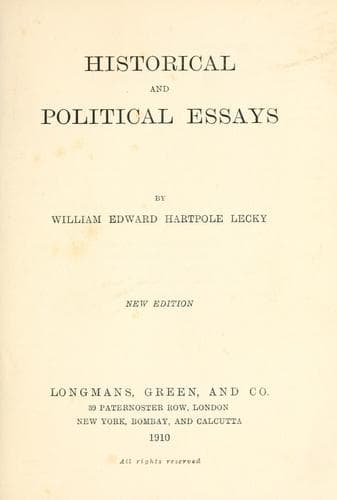
Historical and Political EssaysLecky, William Edward Hartpole
History
Historical and Political Essays
Lecky, William Edward Hartpole
History; Political science
A writer of extraordinary brilliancy and power was at this time
exercising a great influence either of attraction or repulsion on all
serious students of history. Those who are old enough to remember the
appearance of the first volume of Buckle's 'History,' in 1857, and of
the second volume, in 1861, will remember also how rapidly and how
passionately it divided opinion. It was in truth a book in which
extraordinary merits were balanced by extraordinary defects. On the
special subject of the growth of religions, which most interested me,
it was peculiarly deficient, for with all his great gifts Buckle was
almost colour-blind to the devotional and reverential aspect of things,
and he had little more power than Whately of projecting himself into
the beliefs, ideals, and modes of thought of other men and ages. His
unqualified, undiscriminating contempt for the ages of superstition is
the more remarkable, because fifteen years before the appearance of his
first volume, Comte, with whom Buckle had some affinity, and for whom
he expressed great admiration, had been placing those ages on a
pinnacle of extravagant eulogy. His doctrine that there is no real
progress in moral ideas and no real history of morals, I have always
believed to be profoundly untrue, and to have vitiated a large part of
his conclusions; and although he rendered valuable service in showing
by ample illustrations that the capital changes in history are much
less due to the great men who directly effected them than to the long
train of intellectual, political, or industrial tendencies that had
prepared them, he pushed this, like many of his other generalisations,
to exaggeration and even to extravagance. Individuals, and even
accidents, have had a great modifying and deflecting influence in
history, and sometimes the part they have played can scarcely be
over-estimated. If, as I have elsewhere said, a stray dart had struck
down Mohammed in one of the early skirmishes of his career, there is no
reason to believe that the world would have seen a great military and
monotheistic religion arise in Arabia, powerful enough to sweep over a
large part of three continents, and to mould during many centuries the
lives and characters of about a fifth part of the human race. In one
respect, too, Buckle was singularly unfortunate in the time in which he
appeared. From the days of Bacon and Locke to the days of Condillac and
Bentham, it had been the tendency of advanced liberal thinkers to
aggrandise as much as possible the power of circumstances and
experience over the individual, and to reduce to the narrowest limits
every influence that is innate, transmitted, or hereditary. They
represented man as essentially the creature of circumstances, and his
mind as a sheet of blank paper on which education might write what it
pleased. Buckle pushed this habit of thought so far that he even
questioned the reality of such an evident and well-known fact as
hereditary insanity.
Public-domain text, read in full here on John Shaqi.
Reviews
Reviews
No reviews yet
Be the first to share your thoughts on this work.
Elsewhere in the archive
Join the Discussion
Join the discussion
Sign in to leave a comment or review.
Sign InorCreate an account