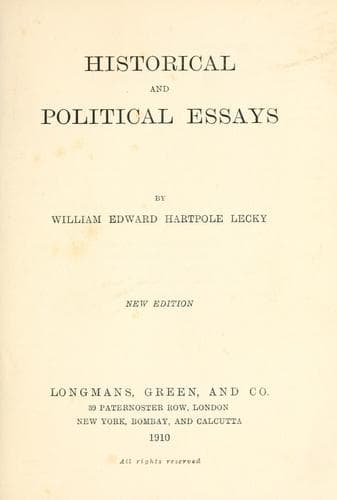
Historical and Political EssaysLecky, William Edward Hartpole
History
Historical and Political Essays
Lecky, William Edward Hartpole
History; Political science
He scandalised--and I think with a good deal of reason--most of his
contemporaries by the ridicule which he threw upon the career of
Howard, and upon the great movement for prison reform which was so
actively pursued in his time. Much of what he wrote on this subject
is, to me at least, very repulsive; but you will generally find in the
most extravagant utterances of Carlyle that there is some true meaning
at bottom. He maintained that the passion for reforming and improving
prisons and prison-life had been carried in England to such a point
that the lot of a convicted criminal was often much better than that
of an honest and struggling artisan. He believed that a just and wise
distribution of compassion is a most important element of national
well-being, and that the English people are very apt to be indifferent
to great masses of unobtrusive, struggling, honourable, unsensational
poverty at their very doors, while they fall into paroxysms of emotion
about the actors in some sensational crime, about some seductive
murderess, about the wrongs of some far-off and often half-savage
race. 'In one of these Lancashire weavers dying with hunger there is
more thought and heart, a greater arithmetical amount of misery and
desperation, than in whole gangs of Quashees.' He maintained, too,
that a strain of sentiment about criminals was very prevalent in his
day, which tended seriously to obliterate or diminish the real
difference between right and wrong. He hated with an intense hatred
that whole system of philosophy which denied that there was a deep,
essential, fundamental difference between right and wrong, and turned
the whole matter into a mere calculation of interests. He was
accustomed to say that one of the chief merits of Christianity was
that it taught that right and wrong were as far apart as Heaven and
Hell, and that no greater calamity can befall a nation than a
weakening of the righteous hatred of evil.
The parts of Carlyle's teaching on which I have dwelt to-day will be
chiefly found in his 'Past and Present,' his 'Heroes and Hero
Worship,' his 'Latter-day Pamphlets,' his 'Chartism,' and in the two
admirable essays called 'Signs of the Times' and 'Characteristics.' In
my own opinion, though Carlyle teaches much, his writings are most
valuable as a moral force. Very few great writers have maintained more
steadily that the moral element is the deepest and most important part
of our being, deeper and stronger than all intellectual
considerations. In his writings, amid much that has imperishable
value, there is, I think, much that is exaggerated, much that is
one-sided, much that is unwise. But no one can be imbued with his
teaching without finding it a great moral tonic, and deriving from it
a nobler, braver, and more unworldly conception of human life.
ISRAEL AMONG THE NATIONS[8]
Public-domain text, read in full here on John Shaqi.
Reviews
Reviews
No reviews yet
Be the first to share your thoughts on this work.
Elsewhere in the archive
Join the Discussion
Join the discussion
Sign in to leave a comment or review.
Sign InorCreate an account