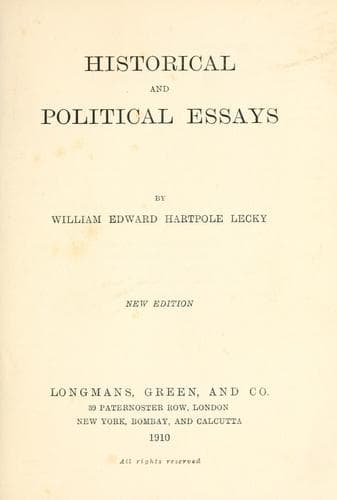
Historical and Political EssaysLecky, William Edward Hartpole
History
Historical and Political Essays
Lecky, William Edward Hartpole
History; Political science
That persecution, he justly says, unites in different degrees three of
the most powerful elements that can move mankind--the spirit of
religious intolerance; the spirit of exclusive nationality; and the
jealousy which springs from trade or mercantile competition. Of these
elements M. Leroy-Beaulieu considers the first to be on the whole the
weakest. In that hideous Russian Persecution which 'the New Exodus' of
Frederic has made familiar to the English reader, the religious
element certainly occupies a very leading place. Pobedonosteff, who
shared with his master the chief guilt and infamy of this atrocious
crime, belonged to the same type as the Torquemadas of the past, and
the spirit that animated him has entered largely into the anti-Semite
movement in other lands. The 'Gloria' of Galdos, perhaps the most
powerful religious novel of our time, describes the conflict in modern
Spain of the fanaticism of Catholicism with the fanaticism of Judaism.
Even the old calumny that the Jews are accustomed at Easter to murder
Christian children in order to mix their blood with the passover
bread, is still living in many parts of Europe. M. Leroy-Beaulieu has
collected much curious evidence on the subject. It is a calumny which
appears first to have become popular about 1100 A.D. It is
embodied in a well-known tale of Chaucer. It is the subject of one of
the great frescoes that were painted around the Cathedral of Toledo to
commemorate the expulsion of the Jews from Spain. Two Popes of the
thirteenth century, to their great honour, declared its falsehood,
and by the order of Benedict XIV. Ganganelli wrote a full memoir
examining and refuting it. But in spite of all condemnations, in spite
of many exposures in the law courts, it is still a popular belief in
Russia, Poland, Roumania, Hungary, and Bohemia, and even within the
last ten years it has been the direct cause of many outrages against
the Jews.
Another element to which M. Leroy-Beaulieu attaches considerable
importance is the Kultur Kampf in Germany. When the German Government
was engaged in its fierce struggle with the Catholics, these
endeavoured to effect a diversion and to avenge themselves on papers,
which were largely in the hands of Jews, by raising a new cry. They
declared that a Kultur Kampf was indeed needed, but that it should be
directed against the alien people who were undermining the moral
foundations of Christian societies; who were the implacable enemies of
the Christian creed and of Christian ideals. The cry was soon taken up
by a large body of Evangelical Protestants. The 'Germania' and the
'Civiltà Cattolica,' which were the chief organs of Ultramontanism in
Germany and Italy, and the 'Kreuz Zeitung,' which represented the
strictest forms of German Protestantism, agreed in fomenting it.
Public-domain text, read in full here on John Shaqi.
Reviews
Reviews
No reviews yet
Be the first to share your thoughts on this work.
Elsewhere in the archive
Join the Discussion
Join the discussion
Sign in to leave a comment or review.
Sign InorCreate an account