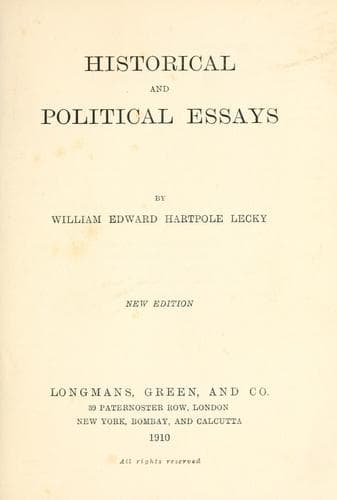
Historical and Political EssaysLecky, William Edward Hartpole
History
Historical and Political Essays
Lecky, William Edward Hartpole
History; Political science
The force of these causes is undoubted, but they are not, I think, the
only elements to be considered. M. Leroy-Beaulieu appears to me to
have somewhat underrated the physiological force and tenacity of the
Jewish race-type. Following the line of reasoning of a remarkable
essay of Renan, he shows very clearly that the modern Jews are far
from being pure Semites. He proves from Josephus and from other
sources that there was a considerable period, both before and after
the Christian era, when great numbers of Greeks, Latins, and Egyptians
adopted the Jewish faith; that much alien blood afterward poured into
the race through conversions among the barbarians and through the
circumcision of the slaves of Jewish masters, and that there is even
reason to believe that, in some periods of history, marriages with
Christians were not infrequent. It is probable, however, that most
alien elements that were introduced into the race sooner or later
mingled with the old stock, and no fact is more clearly shown than the
extraordinary power of the Jewish type to survive and dominate in a
mixed race. A single instance of a marriage with a Jewess will be
sufficient to perpetuate it in a family for many generations. In this
fact the Jews possess an element of stability which is wholly
independent of all considerations of creed and ritual. Few things are
more curious than the effect of persecution on the Jewish element in
Spain and Portugal. Tens of thousands of Jews in those countries were
burned at the stake or driven into exile, but great numbers also
conformed. They mixed in a few generations with the old Christian
population, and Spain and Portugal, M. Leroy-Beaulieu truly says, are
now among the countries in which the Jewish blood is most evidently
and most widely diffused.
Another consideration, which M. Leroy-Beaulieu has omitted to mention,
but which appears to me to have much weight, is the condemnation of
lending money at interest by the Church. This condemnation, which
lasted many centuries, had two important consequences. One of them was
that the Jews became almost the only moneylenders in Europe. The trade
was deemed sinful for a Christian, but it was found to be a very
necessary one; and the Jews (as some Catholic theologians observed)
being already damned, were allowed to practise it. The other
consequence was that on account of the stigma which the Church
attached to moneylending, the amount of money to be lent was greatly
diminished, or in other words, the rate of interest was enormously and
artificially raised. At a time, therefore, when Catholic intolerance
made it impossible for the Jews to mingle with and be absorbed in
surrounding nations they acquired one of the greatest elements of
power and stability that a race can possess--a monopoly of the most
lucrative trade in the world.
Public-domain text, read in full here on John Shaqi.
Reviews
Reviews
No reviews yet
Be the first to share your thoughts on this work.
Elsewhere in the archive
Join the Discussion
Join the discussion
Sign in to leave a comment or review.
Sign InorCreate an account