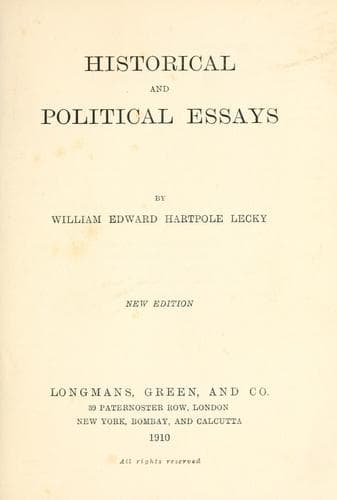
Historical and Political EssaysLecky, William Edward Hartpole
History
Historical and Political Essays
Lecky, William Edward Hartpole
History; Political science
The causes of this inferiority may be easily explained. Life pursued
during many generations in the crowded Ghetto; the sordid habits that
grow out of extreme poverty and out of the assumption of the
appearance of poverty, which is natural in a persecuted and plundered
race, go far to explain it; but there is another and, I think, a more
important cause which M. Leroy-Beaulieu has rather strangely
neglected. Physical strength and beauty can be maintained at a high
level in crowded town populations only by a constant influx from the
country. The pure air and the healthy labour of the fields are their
main source. This great school of health the Jews have never known.
For many centuries it would have been impossible for them to have
lived in peace as farmers or agricultural labourers among a Christian
peasantry, and if they ever possessed any aptitude or taste for
agricultural pursuits they have long since wholly lost it.
Their moral like their physical characteristics present strange
contrasts. No natural want of moral elevation or tenderness or grace
can be ascribed to the nation that has produced both the Old Testament
and the Gospels, and has most largely shaped and inspired the moral
life of the civilised world. In Christian times no race has maintained
its faith with a more devoted courage, and it has encountered and
survived persecutions before which the persecutions of other creeds
dwindle almost into insignificance. M. Leroy-Beaulieu quotes the
statement of the grand Rabbi Lehmann, that it is a clearly attested
fact that in two months of the year 1096 twelve thousand Jews, whose
names have been preserved, were massacred in the towns of the Rhine
alone, because they refused to accept a Christian baptism. The Spanish
Jews who perished by one of the most excruciating deaths rather than
forswear their faith may be numbered by thousands, and those who
preferred exile and spoliation to apostasy, by hundreds of thousands.
Even in our own sceptical and materialising age the conduct of the
Russian Jews under the recent savage persecution shows that the old
spirit is not extinct. In the face of the long and splendid roll of
Jewish heroism, it is idle to dwell on the fact that in each great
persecution some Jews have yielded to the fear of death and consented
to perform the rites of a faith which they inwardly abhorred, or on
the fact that a few Rabbis have under such circumstances justified
these feigned conversions.
Public-domain text, read in full here on John Shaqi.
Reviews
Reviews
No reviews yet
Be the first to share your thoughts on this work.
Elsewhere in the archive
Join the Discussion
Join the discussion
Sign in to leave a comment or review.
Sign InorCreate an account