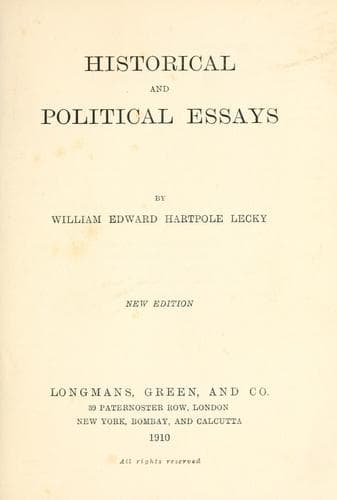
Historical and Political EssaysLecky, William Edward Hartpole
History
Historical and Political Essays
Lecky, William Edward Hartpole
History; Political science
It is probable that these defects will gradually diminish, and it
would be a grave error to regard the Jewish race as wholly devoted to
material ends. The multitude of their martyrs is a sufficient answer
to the charge, and no people cherish more strongly the ideals of their
past and have more of the pride both of race and of creed. They have
at all times, as M. Leroy-Beaulieu observes, been distinguished for
their reverence for learning, and it is an undoubted fact that Jewish
families and families mixed with Jewish blood have produced an amount
and variety of ability that far exceed the average of men. The ability
goes rather with the race than with the religion. Spinosa, Heine,
Ricardo, and Disraeli--to quote but a few of the most illustrious
names--were not believers in the synagogue. Some of the forms in which
the Jews have most excelled are such as might have been expected from
their past. It is natural that the descendants of the most nomadic
and cosmopolitan of races should have been great masters of language
and in the foremost rank of philologists, and it is not surprising
that the descendants of the chief moneylenders and calculators of the
world should have produced great financiers, and have shown a very
eminent aptitude for mathematics. Medicine more than most professions
depends on individual ability, and has been exercised independently of
the favour of Churches and Governments, and in medicine the Jews were
for a long period pre-eminent. Their marked taste and turn for music
may appear more surprising. It is universally recognised and is
sufficiently evident to anyone who will look at the faces of the chief
orchestras of Europe. Besides a crowd of lesser names they have
produced among composers Mendelssohn, Meyerbeer, and Halévy, and among
contemporary performers Rubinstein, Joachim, Hermann Levy, and Lucca.
A Jewess is the most popular tragic actress on the contemporary stage,
and another Jewess was probably the greatest tragic actress of the
century. M. Leroy-Beaulieu notices that in painting and sculpture the
Jews have been less conspicuous, and he attributes this to their
horror of idolatry. I should rather ascribe it to the fact that
European art in its best period was mainly devoted to depicting
Christian subjects for Christian churches. At all events several
considerable Jewish names may be cited in contemporary art, and the
Dutch painter who bears the name of Israels is perhaps the greatest
living master of the pathetic in painting. In Western Europe, wherever
public life has been opened to them, Jews have thrown themselves into
almost all the great movements of their time and have distinguished
themselves in nearly all. Crémieux, who was a leading figure in the
French Republic of 1848, was a Jew both by birth and by creed. David
Manin and Léon Gambetta had Jewish blood in their veins. Lassalle and
Marx, the chief names in German socialism, as well as great numbers of
Public-domain text, read in full here on John Shaqi.
Reviews
Reviews
No reviews yet
Be the first to share your thoughts on this work.
Elsewhere in the archive
Join the Discussion
Join the discussion
Sign in to leave a comment or review.
Sign InorCreate an account