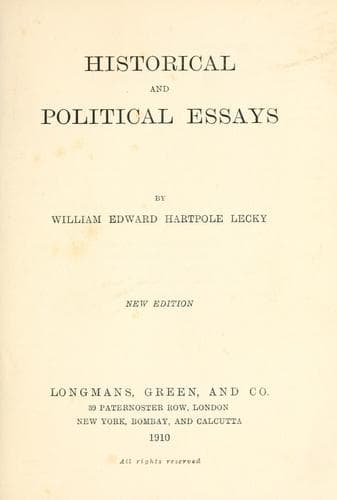
Historical and Political EssaysLecky, William Edward Hartpole
History
Historical and Political Essays
Lecky, William Edward Hartpole
History; Political science
It was a saying of Talleyrand that he who had not lived before 1789
had never known the full charm of life. Germaine Necker grew up in the
last bright flush of a society which had, perhaps, as many
fascinations as any that the world has known. Her mother, however,
though she occupied a prominent position in this brilliant world, was
never altogether of it. She shared fully, indeed, its intellectual
tastes, and had herself won some small place in literature. She threw
herself ardently into its philanthropic movements, and especially into
that for the reform of the hospitals. She formed a warm and true
friendship with Buffon and Thomas. She corresponded with Voltaire, and
attracted to her house most of the best writers of the age. But to the
last she remained eminently and characteristically Swiss, and she
never acquired the light touch, or the easy, pliant grace, of the true
Parisian. She was a little cold, a little prim, a little pedantic, a
little self-conscious. Neither her reserved manners nor her strong
domestic tastes, nor the vein of Puritanism that ran through her
opinions, harmonised with the lax and sceptical society around her,
and it was no sacrifice to her to exchange the splendours and the
gaieties of Paris for her peaceful retreat on the Lake of Geneva.
In this, as in most respects, her daughter was very different. In her
the Swiss element had altogether disappeared, and, as is often the
case with the eminent child of eminent parents, her character shot out
in directions wholly unlike both that of her father and that of her
mother. She was not beautiful, though her dark and eminently lustrous
eyes, beaming with intelligence, and her rich brown tint, gave some
charm to her large and rather coarse features; while her massive
shoulders, arms, and breast, her full lips and the firm grasp of her
vigorous hand, indicated a strong, frank, ruling, and passionate
nature, overflowing with life and with many forms of energy. Her
education was somewhat fitfully conducted, but she threw herself
eagerly into literary enthusiasms. At fifteen we find her annotating
Montesquieu. Raynal and Richardson were among her idols, but, like
most of the more ardent spirits of her generation, her ideas and
character were moulded chiefly by the genius of Rousseau. Her first
work of importance was an exposition of his doctrines, and his
influence left deep traces on both 'Corinne' and 'Delphine.' Her
strong sane judgment, however, her genuine humanity, and the
moderating influence of her father, saved her from being swept away,
like Madame Roland and most of the disciples of Rousseau, by the
sanguinary torrent of revolutionary enthusiasm; and in times of wild
passion and exaggeration she usually exhibited a singular soundness
and sobriety of political judgment. She was sometimes mistaken, but on
the whole it may well be doubted whether there is any other French
writer or politician of the period of the Revolution whose
Public-domain text, read in full here on John Shaqi.
Reviews
Reviews
No reviews yet
Be the first to share your thoughts on this work.
Elsewhere in the archive
Join the Discussion
Join the discussion
Sign in to leave a comment or review.
Sign InorCreate an account