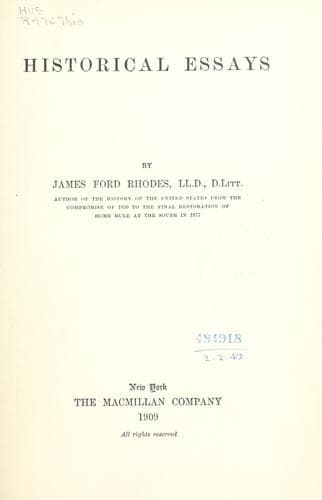
Great Britain -- History; History; United States -- History
I shall first speak of Mr. Pierce as an author. His Life of Sumner it
seems to me is an excellent biography, and the third and fourth volumes
of it are an important contribution to the history of our country. Any
one who has gone through the original material of the period he embraces
must be struck not only with the picture of Sumner, but with the skill
of the biographer in the use of his data to present a general historical
view. The injunction of Cicero, "Choose with discretion out of the
plenty that lies before you," Mr. Pierce observed. To those who know how
extensive was his reading of books, letters, newspaper files, how much
he had conversed with the actors in those stirring scenes--and who will
take into account the mass of memories that crowd upon the mind of one
who has lived through such an era--this biography will seem not too long
but rather admirable in its relative brevity. In a talk that I had with
Mr. Pierce I referred to the notice in an English literary weekly of his
third and fourth volumes which maintained that the biography was twice
too long, and I took occasion to say that in comparison with other
American works of the kind the criticism seemed unjust. "Moreover," I
went on, "I think you showed restraint in not making use of much of your
valuable material,--of the interesting and even important unprinted
letters of Cobden, the Duke of Argyll, and of John Bright." "Yes,"
replied Mr. Pierce, with a twinkle in his eye, "I can say with Lord
Clive, 'Great Heavens, at this moment I stand astonished at my own
moderation.'"
Any one who has studied public sentiment in this country for any period
knows how easy it is to generalize from a few facts, and yet, if the
subject be more thoroughly investigated, it becomes apparent how
unsatisfactory such generalizations are apt to be; not that they are
essentially untrue, but rather because they express only a part of the
truth. If a student should ask me in what one book he would find the
best statement of popular opinion at the North during the Civil War, I
should say, Read Sumner's letters as cited in Mr. Pierce's biography
with the author's comments. The speeches of Sumner may smell too much of
the lamp to be admirable, but the off-hand letters written to his
English and to a few American friends during our great struggle are
worthy of the highest esteem. From his conversations with the President,
the Cabinet ministers, his fellow-senators and congressmen, his
newspaper reading,--in short, from the many impressions that go to make
up the daily life of an influential public man,--there has resulted an
accurate statement of the popular feeling from day to day. In spite of
his intense desire to have Englishmen of power and position espouse the
right side, he would not misrepresent anything by the suppression of
facts, any more than he would make a misleading statement. In the
selection of these letters Mr. Pierce has shown a nice discrimination.
Public-domain text, read in full here on John Shaqi.
Reviews
Reviews
No reviews yet
Be the first to share your thoughts on this work.
Elsewhere in the archive
Join the Discussion
Join the discussion
Sign in to leave a comment or review.
Sign InorCreate an account