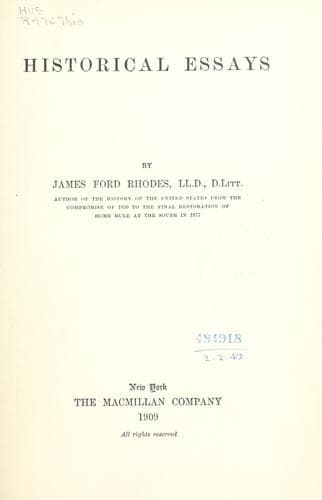
Great Britain -- History; History; United States -- History
Besides the doctor's thesis, Bourne published two books, the first of
which was "Essays in Historical Criticism," one of the Yale bicentennial
publications, the most notable essay in which is that on Marcus Whitman.
A paper read at the Ann Arbor session of the American Historical meeting
in Detroit and later published in the _American Historical Review_ is
here amplified into a long and exhaustive treatment of the subject. The
original paper gained Bourne some celebrity and subjected him to some
harsh criticism, both of which, I think, he thoroughly enjoyed. Feeling
sure of his facts and ground, he delighted in his final word to support
the contention which he had read with emphasis and pleasure to an
attentive audience in one of the halls of the University of Michigan.
The final paragraph sums up what he set out to prove with undoubted
success:
That Marcus Whitman was a devoted and heroic missionary who braved
every hardship and imperilled his life for the cause of Christian
missions and Christian civilization in the far Northwest and finally
died at his post, a sacrifice to the cause, will not be gainsaid.
That he deserves grateful commemoration in Oregon and Washington is
beyond dispute. But that he is a national figure in American
history, or that he "saved" Oregon, must be rejected as a fiction
[p. 100].
Bourne had a good knowledge of American history, and he specialized on
the Discoveries period, to which he gave close and continuous attention.
He was indebted to Professor Hart's ambitious and excellent cooperative
history, "The American Nation," for the opportunity to obtain a hearing
on his favorite subject. His "Spain in America," his third published
book, is the book of a scholar. While the conditions of his narrative
allowed only forty-six pages to the story of Columbus, he had
undoubtedly material enough well arranged and digested to fill the
volume on this topic alone. I desire to quote a signal example of
compression:
It was November, 1504, when Columbus arrived in Seville, a broken
man, something over twelve years from the time he first set sail
from Palos. Each successive voyage since his first had left him at a
lower point. On his return from the second he was on the defensive;
after his third he was deprived of his viceroyalty; on his fourth he
was shipwrecked.... The last blow, the death of his patron Isabella,
soon followed. It was months before he was able to attend court.
His strength gradually failed, he sank from public view, and on the
eve of Ascension Day, May 20, 1506, he passed away in obscurity
[p. 81].
And I am very fond of this final characterization:
Public-domain text, read in full here on John Shaqi.
Reviews
Reviews
No reviews yet
Be the first to share your thoughts on this work.
Elsewhere in the archive
Join the Discussion
Join the discussion
Sign in to leave a comment or review.
Sign InorCreate an account