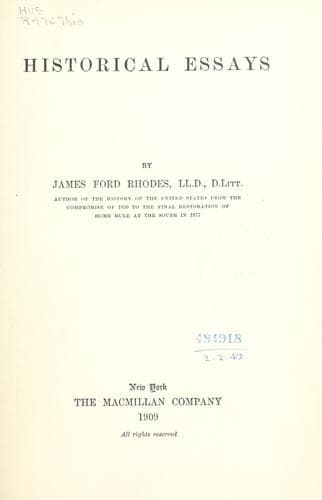
Great Britain -- History; History; United States -- History
An American may judge his own country best from European soil,
impregnated as he there is with European ideas. Twice have I been in
Europe during Cleveland's administration, twice during McKinley's, once
during Roosevelt's. During the natural process of comparison, when one
must recognize in many things the distinct superiority of England,
Germany, and France, I have never had a feeling other than high respect
for each one of these Presidents; and taking it by and large, in the
endeavor to consider fairly the hits and misses of all, I have never had
any reason to feel that the conduct of our national government has been
inferior to that of any one of these highly civilized powers.
[164] Henry Adams, II, 113.
[165] _Ibid._, 130.
[166] Sumner's Jackson, 138.
[167] Twenty Years of Congress, II, 185.
[168] July 14, 1900.
[169] See also the _Federalist_ (Lodge's edition), 452. Bryce,
Studies in History and Jurisprudence, 308.
[170] American Commonwealth, I, 80.
A REVIEW OF PRESIDENT HAYES'S ADMINISTRATION
Address delivered at the annual meeting of the Graduate School of Arts
and Sciences, and the Graduate Schools of Applied Science and Business
Administration, Harvard University, on October 8, 1908; printed in the
_Century Magazine_ for October, 1909.
A REVIEW OF PRESIDENT HAYES'S ADMINISTRATION
Many of our Presidents have been inaugurated under curious and trying
circumstances, but no one of them except Hayes has taken the oath of
office when there was a cloud on his title. Every man who had voted for
Tilden,--whose popular vote exceeded that of Hayes by 264,000,--believed
that Hayes had reached his high place by means of fraud. Indeed, some of
the Hayes voters shared this belief, and stigmatized as monstrous the
action of the Louisiana returning board in awarding the electoral vote
of Louisiana to Hayes. The four men, three of them dishonest and the
fourth incompetent, who constituted this returning board, rejected, on
the ground of intimidation of negro voters, eleven thousand votes that
had been cast in due form for Tilden. In the seventh volume of my
history I have told the story of the compromise in the form of the
Electoral Commission which passed on the conflicting claims and adjudged
the votes of the disputed states, notably Florida and Louisiana, to
Hayes, giving him a majority of one in the electoral college, thus
making him President. When the count was completed and the usual
declaration made, Hayes had no choice but to abide by the decision. Duty
to his country and to his party, the Republican, required his acceptance
of the office, and there is no reason for thinking that he had any
doubts regarding his proper course. His legal title was perfect, but his
moral title was unsound, and it added to the difficulty of his situation
that the opposition, the Democrats, had a majority in the House of
Representatives. None but a determined optimist could have predicted
Public-domain text, read in full here on John Shaqi.
Reviews
Reviews
No reviews yet
Be the first to share your thoughts on this work.
Elsewhere in the archive
Join the Discussion
Join the discussion
Sign in to leave a comment or review.
Sign InorCreate an account