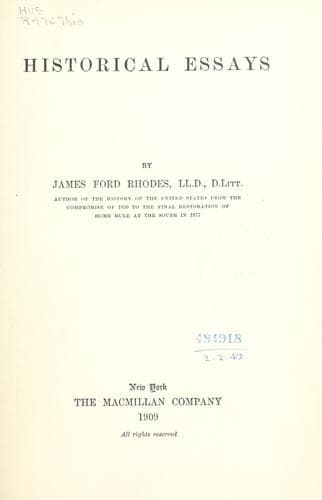
Great Britain -- History; History; United States -- History
In recalling his predecessor in office, we think more gladly of the
Grant of Donelson, Vicksburg, and Appomattox than of Grant the
President, for during his two administrations corruption was rife and
bad government to the fore. Financial scandals were so frequent that
despairing patriots cried out, "Is there no longer honesty in public
life?" Our country then reached the high-water mark of corruption in
national affairs. A striking improvement began under Hayes, who infused
into the public service his own high ideals of honesty and efficiency.
Hayes was much assisted in his social duties by his wife, a woman of
character and intelligence, who carried herself with grace and dignity.
One sometimes heard the remark that as Hayes was ruled in political
matters by John Sherman, so in social affairs he was ruled by his wife.
The sole foundation for this lay in his deference to her total
abstinence principles, which she held so strongly as to exclude wine
from the White House table except, I believe, at one official dinner,
that to the Russian Grand Dukes.
Hayes's able Cabinet was likewise a harmonious one. Its members were
accustomed to dine together at regular intervals (fortnightly, I think),
when affairs of state and other subjects were discussed, and the
geniality of these occasions was enhanced by a temperate circulation of
the wine bottle. There must have been very good talk at these social
meetings. Evarts and Schurz were citizens of the world. Evarts was a man
of keen intelligence and wide information, and possessed a genial as
well as a caustic wit. Schurz could discuss present politics and past
history. He was well versed in European history of the eighteenth
century and the Napoleonic wars, and could talk about the power of
Voltaire in literature and the influence of Lessing on Goethe. From
appreciative discourse on the Wagner opera and the French drama, he
could, if the conversation turned to the Civil War, give a lively
account of the battles of Chancellorsville or Gettysburg, in both of
which he had borne an honorable part. Sherman was not a cosmopolitan
like his two colleagues, but he loved dining out. His manners were those
of the old-school gentleman; he could listen with genial appreciation,
and he could talk of events in American history of which he had been a
contemporaneous observer; as, for example, of the impressive oratory of
Daniel Webster at a dinner in Plymouth; or the difference between the
national conventions of his early political life and the huge ones of
the present, illustrating his comparison with an account of the Whig
convention of 1852, to which he went as a delegate.
Public-domain text, read in full here on John Shaqi.
Reviews
Reviews
No reviews yet
Be the first to share your thoughts on this work.
Elsewhere in the archive
Join the Discussion
Join the discussion
Sign in to leave a comment or review.
Sign InorCreate an account