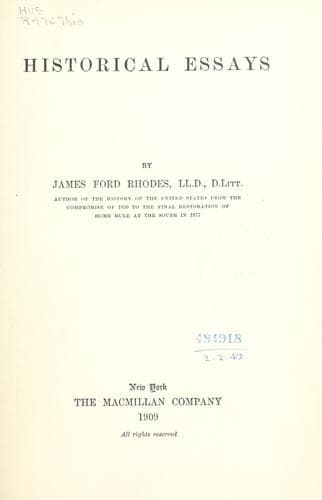
Great Britain -- History; History; United States -- History
Before I touch on certain specifications I must premise that the
influence of this journal on a Westerner, who read it in a receptive
spirit, was probably more potent than on one living in the East. The
arrogance of a higher civilization in New York, Boston, and Philadelphia
than elsewhere in the United States, the term "wild and woolly West,"
applied to the region west of the Alleghany Mountains, is somewhat
irritating to a Westerner. Yet it remains none the less true that, other
things being equal, a man living in the environment of Boston or New
York would have arrived more easily and more quickly at certain sound
political views I shall proceed to specify than he would while living in
Cleveland or Chicago. The gospel which Godkin preached was needed much
more in the West than in the East; and his disciples in the western
country had for him a high degree of reverence. In the biography of
Godkin, allusion is made to the small pecuniary return for his work, but
in thinking of him we never considered the money question. We supposed
that he made a living; we knew from his articles that he was a
gentleman, and saw much of good society, and there was not one of us who
would not rather have been in his shoes than in those of the richest man
in New York. We placed such trust in him--which his life shows to have
been abundantly justified--that we should have lost all confidence in
human nature had he ever been tempted by place or profit. And his
influence was abiding. Presidents, statesmen, senators, congressmen rose
and fell; political administrations changed; good, bad, and weak public
men passed away; but Godkin preached to us every week a timely and
cogent sermon.
To return now to my personal experience. I owe wholly to _The Nation_ my
conviction in favor of civil service reform; in fact, it was from these
columns that I first came to understand the question. The arguments
advanced were sane and strong, and especially intelligible to men in
business, who, in the main, chose their employees on the ground of
fitness, and who made it a rule to retain and advance competent and
honest men in their employ. I think that on this subject the indirect
influence of _The Nation_ was very great, in furnishing arguments to men
like myself, who never lost an opportunity to restate them, and to
editorial writers for the Western newspapers, who generally read _The
Nation_ and who were apt to reproduce its line of reasoning. When I look
back to 1869, the year in which I became a voter, and recall the
strenuous opposition to civil service reform on the part of the
politicians of both parties, and the indifference of the public, I
confess that I am amazed at the progress which has been made. Such a
reform is of course effected only by a number of contributing causes and
some favoring circumstances, but I feel certain that it was accelerated
by the constant and vigorous support of _The Nation_.
Public-domain text, read in full here on John Shaqi.
Reviews
Reviews
No reviews yet
Be the first to share your thoughts on this work.
Elsewhere in the archive
Join the Discussion
Join the discussion
Sign in to leave a comment or review.
Sign InorCreate an account