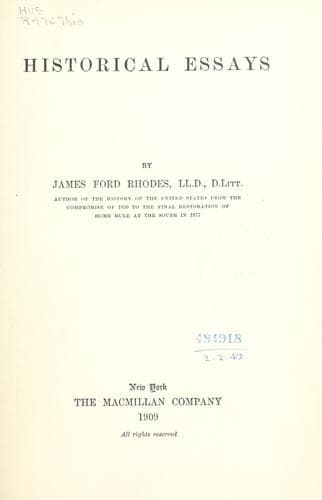
Great Britain -- History; History; United States -- History
A number of things had combined to affect him profoundly. An admirer of
Grover Cleveland and three times a warm supporter of his candidacy for
the Presidency, he saw with regret the loss of his hold on his party,
which was drifting into the hands of the advocates of free silver. Then
in December, 1895, Godkin lost faith in his idol. "I was thunderstruck
by Cleveland's message" on the Venezuela question, he wrote to Norton.
His submission to the Jingoes "is a terrible shock."[197] Later, in a
calm review of passing events, he called the message a "sudden
declaration of war without notice against Great Britain."[198] The
danger of such a proceeding he had pointed out to Norton: Our "immense
democracy, mostly ignorant ... is constantly on the brink of some
frightful catastrophe like that which overtook France in 1870."[199] In
1896 he was deeply distressed at the country having to choose for
President between the arch-protectionist McKinley and the free-silver
advocate Bryan, for he had spent a good part of his life combating a
protective tariff and advocating sound money. Though the _Evening Post_
contributed powerfully to the election of McKinley, from the fact that
its catechism, teaching financial truths in a popular form, was
distributed throughout the West in immense quantities by the chairman of
the Republican National Committee, Godkin himself refused to vote for
McKinley and put in his ballot for Palmer, the gold Democrat.[200]
The Spanish-American war seems to have destroyed any lingering hope that
he had left for the future of American democracy. He spoke of it as "a
perfectly avoidable war forced on by a band of unscrupulous politicians"
who had behind them "a roaring mob."[201] The taking of the Philippines
and the subsequent war in these islands confirmed him in his despair. In
a private letter written from Paris, he said, "American ideals were the
intellectual food of my youth, and to see America converted into a
senseless, Old-World conqueror, embitters my age."[202] To another he
wrote that his former "high and fond ideals about America were now all
shattered."[203] "Sometimes he seemed to feel," said his intimate
friend, James Bryce, "as though he had labored in vain for forty
years."[204]
Such regrets expressed by an honest and sincere man with a high ideal
must command our respectful attention. Though due in part to old age and
enfeebled health, they are still more attributable to his
disappointment that the country had not developed in the way that he
had marked out for her. For with men of Godkin's positive convictions,
there is only one way to salvation. Sometimes such men are true
prophets; at other times, while they see clearly certain aspects of a
case, their narrowness of vision prevents them from taking in the whole
range of possibilities, especially when the enthusiasm of manhood is
gone.
Public-domain text, read in full here on John Shaqi.
Reviews
Reviews
No reviews yet
Be the first to share your thoughts on this work.
Elsewhere in the archive
Join the Discussion
Join the discussion
Sign in to leave a comment or review.
Sign InorCreate an account