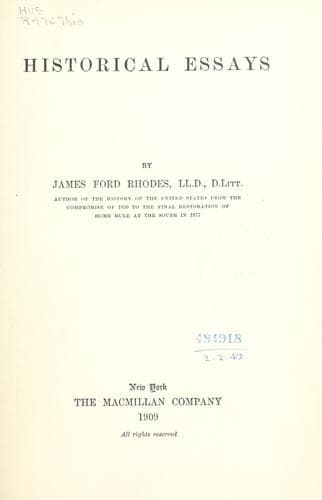
Great Britain -- History; History; United States -- History
Our country, wrapped up in no smug complacency, listened to this man,
respected him and supported him, and on his death a number of people
were glad to unite to endow a lectureship in his honor in Harvard
University.
In closing, I cannot do better than quote what may be called Godkin's
farewell words, printed forty days before the attack of cerebral
hemorrhage which ended his active career. "The election of the chief
officer of the state by universal suffrage," he wrote, "by a nation
approaching one hundred millions, is not simply a novelty in the history
of man's efforts to govern himself, but an experiment of which no one
can foresee the result. The mass is yearly becoming more and more
difficult to move. The old arts of persuasion are already ceasing to be
employed on it. Presidential elections are less and less carried by
speeches and articles. The American people is a less instructed people
than it used to be. The necessity for drilling, organizing, and guiding
it, in order to extract the vote from it is becoming plain; and out of
this necessity has arisen the boss system, which is now found in
existence everywhere, is growing more powerful, and has thus far
resisted all attempts to overthrow it."
I shall not stop to urge a qualification of some of these statements,
but will proceed to the brighter side of our case, which Godkin, even in
his pessimistic mood, could not fail to see distinctly. "On the other
hand," he continued, "I think the progress made by the colleges
throughout the country, big and little, both in the quality of the
instruction and in the amount of money devoted to books, laboratories,
and educational facilities of all kinds, is something unparalleled in
the history of the civilized world. And the progress of the nation in
all the arts, except that of government, in science, in literature, in
commerce, in invention, is something unprecedented and becomes daily
more astonishing. How it is that this splendid progress does not drag
on politics with it I do not profess to know."[219]
Let us be as hopeful as was Godkin in his earlier days, and rest assured
that intellectual training will eventually exert its power in politics,
as it has done in business and in other domains of active life.
[171] R. Ogden's Life and Letters of E. L. Godkin, I, 255.
[172] Rhodes's History of the United States, II, 72 (C. M. Depew).
[173] Ogden, II, 88.
[174] _Ibid._, I, 257.
[175] Parton's Greeley, 331, 576; my own recollections; Ogden, I, 255.
[176] Godkin, Random Recollections, _Evening Post_, December 30, 1899.
[177] Ogden, I, 168.
[178] Ogden, I, 221, 249, 251, 252; II, 222, 231.
[179] Letters of J. R. Lowell, II, 76.
[180] _Ibid._, I, 368.
[181] Ogden, I, 1.
[182] _Evening Post_, December 30, 1899; Ogden, I, 11.
[183] _Evening Post_, December 30, 1899.
[184] _Ibid._; Ogden, I, 113.
Public-domain text, read in full here on John Shaqi.
Reviews
Reviews
No reviews yet
Be the first to share your thoughts on this work.
Elsewhere in the archive
Join the Discussion
Join the discussion
Sign in to leave a comment or review.
Sign InorCreate an account