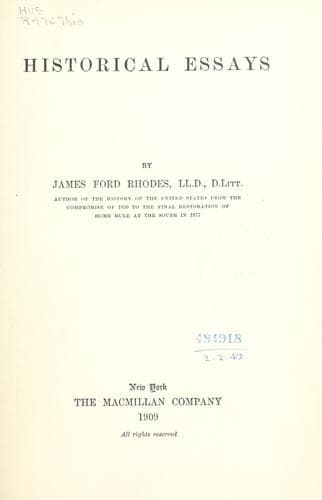
Great Britain -- History; History; United States -- History
To recapitulate, then, what I think I have established: Sherman's
account and that of the Union writers who follow him cannot be accepted
as history. Neither is the version of Wade Hampton and the Southern
writers worthy of credence. Let me now give what I am convinced is the
true relation. My authorities are the contemporary accounts of six
Federal officers, whose names will appear when the evidence is presented
in detail; the report of Major Chambliss of the Confederate army; "The
Sack and Destruction of Columbia," a series of articles in the _Columbia
Phoenix_, written by William Gilmore Simms and printed a little over a
month after the event; and a letter written from Charlotte, February 22,
to the _Richmond Whig_, by F. G. de F., who remained in Columbia until
the day before the entrance of the Union troops.
Two days before the entrance of the Federal troops, Columbia was placed
under martial law, but this did not prevent some riotous conduct after
nightfall and a number of highway robberies; stores were also broken
into and robbed. There was great disorder and confusion in the
preparations of the inhabitants for flight; it was a frantic attempt to
get themselves and their portable belongings away before the enemy
should enter the city. "A party of Wheeler's Cavalry," wrote F. G. de F.
to the _Richmond Whig_, "accompanied by their officers dashed into town
[February 16], tied their horses, and as systematically as if they had
been bred to the business, proceeded to break into the stores along Main
Street and rob them of their contents." Early in the morning of the
17th, the South Carolina railroad depot took fire through the reckless
operations of a band of greedy plunderers, who while engaged in robbing
"the stores of merchants and planters, trunks of treasure, wares and
goods of fugitives," sent there awaiting shipment, fired, by the
careless use of their lights, a train leading to a number of kegs of
powder; the explosion which followed killed many of the thieves and set
fire to the building. Major Chambliss, who was endeavoring to secure the
means of transportation for the Confederate ordnance and ordnance
stores, wrote: "The straggling cavalry and rabble were stripping the
warehouses and railroad depots. The city was in the wildest terror."
Public-domain text, read in full here on John Shaqi.
Reviews
Reviews
No reviews yet
Be the first to share your thoughts on this work.
Elsewhere in the archive
Join the Discussion
Join the discussion
Sign in to leave a comment or review.
Sign InorCreate an account