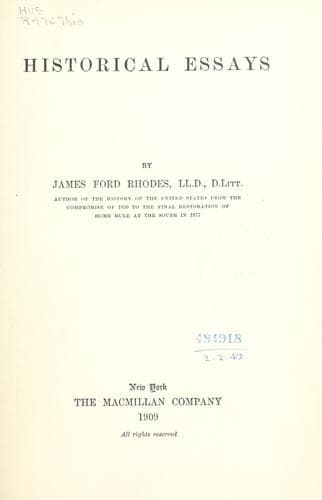
Great Britain -- History; History; United States -- History
I asked Professor Edward Channing of Harvard College, who teaches
English History of the Tudor and Stuart periods, his opinion of
Gardiner. "I firmly believe," he told me, "that Mr. Gardiner is the
greatest English historical writer who has appeared since Gibbon. He has
the instinct of the truth-seeker as no other English student I know of
has shown it since the end of the last century."
General J. D. Cox, a statesman and a lawyer, a student of history and of
law, writes to me: "In reading Gardiner, I feel that I am sitting at the
feet of an historical chief justice, a sort of John Marshall in his
genius for putting the final results of learning in the garb of simple
common sense."
INDEX
Adams, C. F., and E. G. Bourne, 200.
Adams, J. Q., as President, 207, 209.
Adams, John, as President, 207.
Adelaide, Australia, Froude's description, 42.
Alabama claims, arbitration, 218.
Alexander Severus, homage to history, 4.
Alison, Sir Archibald, present-day reputation, 40.
Allison, W. B., and Hayes's New York Custom-house appointments, 255;
and Silver Bill of 1878, 260.
American historians, European recognition, 103.
American Historical Association,
author's addresses before, 1 _n._, 25, 81;
interest of E. G. Bourne, 196.
American history, qualities, 4, 20-23;
newspapers as sources, 29-32, 85-95;
and early English history, 170.
_See also_ Elections, History, Presidential, United States,
and periods by name.
American Revolution, Gibbon on, 113.
Amyot, Jacques, on Alexander Severus, 4.
Ancient history, monopoly of German historians, 75.
_See also_ Ferrero, Gibbon, Herodotus, Tacitus, Thucydides.
Annexations, Philippines, 195, 233, 234, 286;
constitutional control, Louisiana, 208, 211;
and slavery, Texas and California, 212.
Arbitrary arrests during Civil War, 214, 215.
Arbitration, Alabama claims, 218;
Cleveland and Venezuela, 225, 285;
English draft general treaty, 226.
Army, Federal, and suppression of rioting, 225, 253;
character of Cromwell's, 319, 320.
Arnold, Matthew, on Americans, 21;
on Sainte-Beuve, 73;
on criticism, 292.
Arthur, C. A., as President, 222;
removal by Hayes, 255.
Auckland, Lord, on agreeing with Macaulay, 323.
Aulard, F. A., on Taine, 83.
Bagehot, Walter, on presidential office, 204, 217.
Baltimore, railroad riot of 1877, 252.
Balzac, Honore de, importance to historians, 50, 73.
Bancroft, George, use of footnotes, 33;
remuneration, 78;
T. W. Higginson on, over-fondness for manuscript sources, inaccuracy
of quotations, 294.
Beauregard, P. G. T., and burning of Columbia, 304.
Bemis, George, and Lecky, 157.
Bigelow, John, as journalist, 90;
on importance of Godkin to _The Nation_, 275.
Bismarck, Fuerst von, on power of press, 89.
Blaine, J. G., value of "Twenty Years," 33;
on power of Congress over President, 216;
on Hayes and Packard, 248.
Public-domain text, read in full here on John Shaqi.
Reviews
Reviews
No reviews yet
Be the first to share your thoughts on this work.
Elsewhere in the archive
Join the Discussion
Join the discussion
Sign in to leave a comment or review.
Sign InorCreate an account