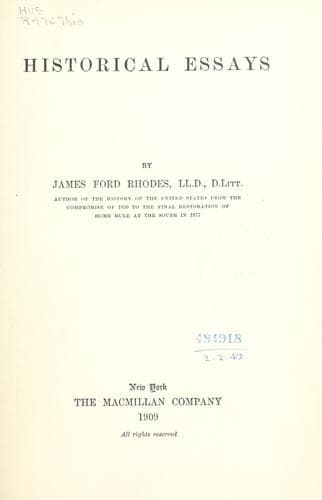
Great Britain -- History; History; United States -- History
It is difficult to guess how long Lecky will be read. His popularity is
distinct. He was the rare combination of a scholar and a man of the
world, made so by his own peculiar talent and by lucky opportunities. He
was not obliged to earn his living. In early life, by intimate personal
intercourse, he drew intellectual inspiration from Dean Milman, and
later he learned practical politics through his friendship with Lord
Russell. He knew well Herbert Spencer, Huxley, and Tyndall. In private
conversation he was a very interesting man. His discourse ran on books
and on men; he turned from one to the other and mixed up the two with a
ready familiarity. He went much into London society, and though entirely
serious and without having, so far as I know, a gleam of humor, he was a
fluent and entertaining talker.
Mr. Lecky was vitally interested in the affairs of this country, and
sympathized with the North during our Civil War. He once wrote to me: "I
am old enough to remember vividly your great war, and was then much with
an American friend--a very clever lawyer named George Bemis--whom I came
to know very well at Rome.... I was myself a decided Northerner, but the
'right of revolution' was always rather a stumbling block." Talking with
Mr. Lecky in 1895, not long after the judgment of the United States
Supreme Court that the income tax was unconstitutional, he expressed the
opinion that it was a grand decision, evidencing a high respect for
private property, but in the next breath came the question, "How are you
ever to manage continuing the payment of those enormous pensions of
yours?"
It is not, I think, difficult to explain why Stubbs and Gardiner are
more precious possessions for students than Lecky. Gardiner devoted his
life to the seventeenth century. If we may reckon the previous
preparation and the ceaseless revision, Stubbs devoted a good part of
his life to the constitutional history from the beginnings of it to
Henry VII. Lecky's eight volumes on the eighteenth century were
published in thirteen years. A mastery of such an amount of original
material as Stubbs and Gardiner mastered was impossible within that
time. Lecky had the faculty of historic divination which compensated to
some extent for the lack of a more thorough study of the sources. Genius
stood in the place of painstaking engrossment in a single task.
Public-domain text, read in full here on John Shaqi.
Reviews
Reviews
No reviews yet
Be the first to share your thoughts on this work.
Elsewhere in the archive
Join the Discussion
Join the discussion
Sign in to leave a comment or review.
Sign InorCreate an account