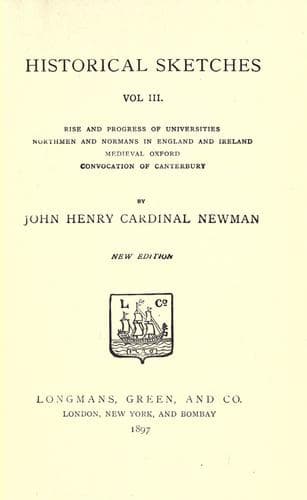
Historical Sketches, Volume I (of 3): The Turks in Their Relation to Europe; Marcus Tullius Cicero; Apollonius of Tyana; Primitive ChristianityNewman, John Henry
HistoryHistory
Historical Sketches, Volume I (of 3): The Turks in Their Relation to Europe; Marcus Tullius Cicero; Apollonius of Tyana; Primitive Christianity
Newman, John Henry
Apollonius, of Tyana; Church history -- Primitive and early church, ca. 30-600; Cicero, Marcus Tullius; Turkey -- History
But I have here been directing your attention to Christianity with no
other view than to illustrate, by the contrast, the condition of the
Mahometan Turks. Their religion is not far from embodying the very dream
of the Judaizing zealots of the Apostolic age. On the one hand, there is
in it the profession of a universal empire, and an empire by conquest;
nay, military success seems to be considered the special note of its
divine origin. On the other hand, I believe it is a received notion with
them that their religion is not even intended for the north of the
earth, for some reasons connected with its ceremonial; nor is there in
it any public recognition, as in intercessory prayer, of the duty of
converting infidels. Certainly, the idea of Mahometan missions and
missionaries, unless an army in the field may be considered to be such,
is never suggested to us by Eastern historian or traveller, as entering
into their religious system. Though the Caliphate, then, may be
transferred from Saracen to Turk, Mahometanism is essentially a
consecration of the principle of nationalism; and thereby is as
congenial to the barbarian as Christianity is congenial to man
civilized. The less a man knows, the more conceited he is of his
proficiency; and, the more barbarous is a nation, the more imposing and
peremptory are its claims. Such was the spirit of the religion of the
Tartars, whatever was the nature of its tenets in detail. It deified the
Tartar race; Zingis Khan was "the son of God, mild and venerable;" and
"God was great and exalted over all, and immortal, but Zingis Khan was
sole lord upon the earth."[85] Such, too, is the strength of the Greek
schism, which there only flourishes where it can fasten on barbarism,
and extol the prerogatives of an elect nation. The Czar is the
divinely-appointed source of religious power; his country is "Holy
Russia;" and the high office committed to him and to it is to extend
what it considers the orthodox faith. The Osmanlis are not behind Tartar
or Russ in pretending to a divine mission; the Sultan, in his treaties
with Christian Powers, calls himself "Refuge of Sovereigns, Distributor
of Crowns to the Kings of the earth, Master of Europe, Asia, and Africa,
and shadow of God upon earth."
Public-domain text, read in full here on John Shaqi.
Reviews
Reviews
No reviews yet
Be the first to share your thoughts on this work.
Elsewhere in the archive
Join the Discussion
Join the discussion
Sign in to leave a comment or review.
Sign InorCreate an account