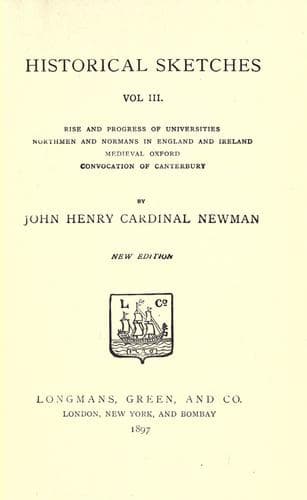
Historical Sketches, Volume I (of 3): The Turks in Their Relation to Europe; Marcus Tullius Cicero; Apollonius of Tyana; Primitive ChristianityNewman, John Henry
HistoryHistory
Historical Sketches, Volume I (of 3): The Turks in Their Relation to Europe; Marcus Tullius Cicero; Apollonius of Tyana; Primitive Christianity
Newman, John Henry
Apollonius, of Tyana; Church history -- Primitive and early church, ca. 30-600; Cicero, Marcus Tullius; Turkey -- History
A far more formidable difficulty, when we survey their external
prospects, is that very peculiarity, which, internally considered, is so
much in their favour--the simplicity of their internal unity, and the
individuality of their political structure. The Turkish races, as being
conquerors, of course are only a portion of the whole population of
their empire; for four centuries they have remained distinct from
Slavonians, Greeks, Copts, Armenians, Curds, Arabs, Jews, Druses,
Maronites, Ansarians, Motoualis; and they never can coalesce with them.
Like other Empires, they have kept their sovereign position by the
insignificance, degeneracy, or mutual animosities of the several
countries and religions which they rule, and by the ruthless tyranny of
their government. Were they to relax that tyranny, were they to
relinquish their ascendancy, were they to place their Greek subjects,
for instance, on a civil equality with themselves, how in the nature of
things could two incommunicable races coexist beside each other in one
political community? Yet if, on the other hand, they refuse this
enfranchisement of their subjects, they will have to encounter the
displeasure of united Christendom.
Nor is it a mere question of political practicability or expedience:
will the Koran, in its laxest interpretation, admit of that toleration,
on which the Frank kingdoms insist? yet what and where are they without
the Koran?
Nor do we understand the full stress of the dilemma in which they are
placed, until we have considered what is meant by the demands and the
displeasure of the European community. Pledged by the very principle of
their existence to barbarism, the Turks have to cope with civilized
governments all around them, ever advancing in the material and moral
strength which civilization gives, and ever feeling more and more
vividly that the Turks are simply in the way. They are in the way of the
progress of the nineteenth century. They are in the way of the Russians,
who wish to get into the Mediterranean; they are in the way of the
English, who wish to cross to the East; they are in the way of the
French, who, from the Crusades to Napoleon, have felt a romantic
interest in Syria; they are in the way of the Austrians, their
hereditary foes. There they lie, unable to abandon their traditionary
principles, without simply ceasing to be a state; unable to retain them,
and retain the sympathy of Christendom;--Mahometans, despots, slave
merchants, polygamists, holding agriculture in contempt, Europe in
abomination, their own wretched selves in admiration, cut off from the
family of nations,[89] existing by ignorance and fanaticism, and
tolerated in existence by the mutual jealousies of Christian powers as
well as of their own subjects, and by the recurring excitement of
military and political combinations, which cannot last for ever.
5.
Public-domain text, read in full here on John Shaqi.
Reviews
Reviews
No reviews yet
Be the first to share your thoughts on this work.
Elsewhere in the archive
Join the Discussion
Join the discussion
Sign in to leave a comment or review.
Sign InorCreate an account