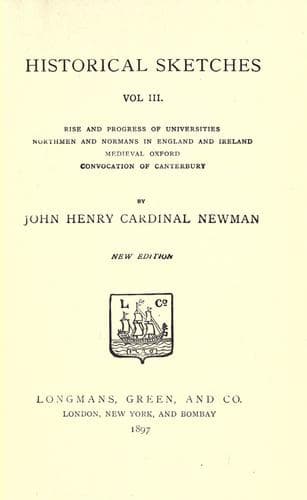
Historical Sketches, Volume I (of 3): The Turks in Their Relation to Europe; Marcus Tullius Cicero; Apollonius of Tyana; Primitive ChristianityNewman, John Henry
HistoryHistory
Historical Sketches, Volume I (of 3): The Turks in Their Relation to Europe; Marcus Tullius Cicero; Apollonius of Tyana; Primitive Christianity
Newman, John Henry
Apollonius, of Tyana; Church history -- Primitive and early church, ca. 30-600; Cicero, Marcus Tullius; Turkey -- History
with feelings of extreme reluctance, dreading perhaps the military
occupations which the movements of the Parthians in that quarter
rendered necessary. Yet if we consider the state and splendour with
which the Proconsuls were surrounded, and the opportunities afforded
them for almost legalized plunder and extortion, we must confess that
this insensibility to the common objects of human cupidity was the token
of no ordinary mind. The singular disinterestedness and integrity of his
administration, as well as his success against the enemy, also belong to
the history of his times. The latter he exaggerated from the desire, so
often instanced in eminent men, of appearing to excel in those things
for which nature has not adapted them.
His return to Italy was followed by earnest endeavours to reconcile
Pompey with Caesar, and by very spirited behaviour when Caesar required
his presence in the Senate. On this occasion he felt the glow of
self-approbation with which his political conduct seldom repaid him: he
writes to Atticus,[116] "I believe I do not please Caesar, but I am
pleased with myself, which has not happened to me for a long while."
However, this effort at independence was but transient. At no period of
his public life did he display such miserable vacillation as at the
opening of the civil war.[117] We find him first accepting a commission
from the Republic; then courting Caesar; next, on Pompey's sailing for
Greece, resolving to follow him thither; presently determining to stand
neuter; then bent on retiring to the Pompeians in Sicily; and, when
after all he had joined their camp in Greece, discovering such timidity
and discontent as to draw from Pompey the bitter reproof, "I wish Cicero
would go over to the enemy, that he may learn to fear us."[118]
On his return to Italy, after the battle of Pharsalia, he had the
mortification of learning that his brother and nephew were making their
peace with Caesar, by throwing on himself the blame of their opposition
to the conqueror. And here we see one of those elevated points of
character which redeem the weaknesses of his political conduct; for,
hearing that Caesar had retorted on Quintus Cicero the charge which the
latter had brought against himself, he wrote a pressing letter in his
favour, declaring his brother's safety was not less precious to him than
his own, and representing him not as the leader, but as the companion of
his voyage.[119]
Public-domain text, read in full here on John Shaqi.
Reviews
Reviews
No reviews yet
Be the first to share your thoughts on this work.
Elsewhere in the archive
Join the Discussion
Join the discussion
Sign in to leave a comment or review.
Sign InorCreate an account