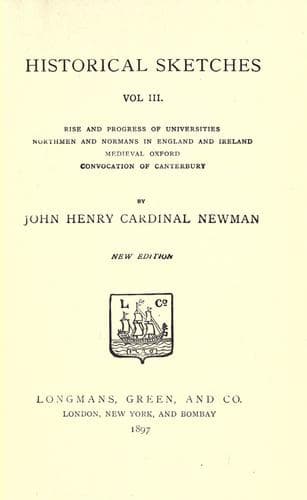
Historical Sketches, Volume I (of 3): The Turks in Their Relation to Europe; Marcus Tullius Cicero; Apollonius of Tyana; Primitive ChristianityNewman, John Henry
HistoryHistory
Historical Sketches, Volume I (of 3): The Turks in Their Relation to Europe; Marcus Tullius Cicero; Apollonius of Tyana; Primitive Christianity
Newman, John Henry
Apollonius, of Tyana; Church history -- Primitive and early church, ca. 30-600; Cicero, Marcus Tullius; Turkey -- History
Some writers, as Lyttelton, have considered it an aggravation of
Cicero's inconsistencies, that he was so perfectly aware, as his
writings show, of what was philosophically and morally upright and
honest. It might be sufficient to reply, that there is a wide difference
between calmly deciding on an abstract point, and acting on that
decision in the hurry of real life; that Cicero in fact was apt to fancy
(as all will fancy when assailed by interest or passion) that the
circumstances of his case constituted it an exception to the broad
principles of duty. Besides, he considered it to be actually the duty of
a statesman to accommodate theoretical principle to the exigencies of
existing circumstances. "Surely," he says in his defence of Plancius,
"it is no mark of inconsistency in a statesman to determine his judgment
and to steer his course by the state of the political weather. This is
what I have been taught, what I have experienced, what I have read; this
is what is recorded in history of the wisest and most eminent men,
whether at home or abroad; namely, that the same man is not bound always
to maintain the same opinions, but those, whatever they may be, which
the state of the commonwealth, the direction of the times, and the
interests of peace may demand."[130] Moreover, he claimed for himself
especially the part of mediator between political rivals; and he
considered it to be a mediator's duty alternately to praise and blame
both parties, even to exaggeration, if by such means it was possible
either to flatter or frighten them into an adoption of temperate
measures.[131] "Cicero," says Plutarch, "used to give them private
advice, keeping up a correspondence with Caesar, and urging many things
upon Pompey himself, soothing and persuading each of them."[132]
5.
But such criticism on Cicero as Lyttelton's proceeds on an entire
misconception of the design and purpose with which the ancients
prosecuted philosophical studies. The motives and principles of morals
were not so seriously acknowledged as to lead to a practical application
of them to the conduct of life. Even when they proposed them in the form
of precept, they still regarded the perfectly virtuous man as the
creature of their imagination rather than a model for imitation--a
character whom it was a mental recreation rather than a duty to
contemplate; and if an individual here or there, as Scipio or Cato,
attempted to conform his life to his philosophical conceptions of
virtue, he was sure to be ridiculed for singularity and affectation.
Public-domain text, read in full here on John Shaqi.
Reviews
Reviews
No reviews yet
Be the first to share your thoughts on this work.
Elsewhere in the archive
Join the Discussion
Join the discussion
Sign in to leave a comment or review.
Sign InorCreate an account