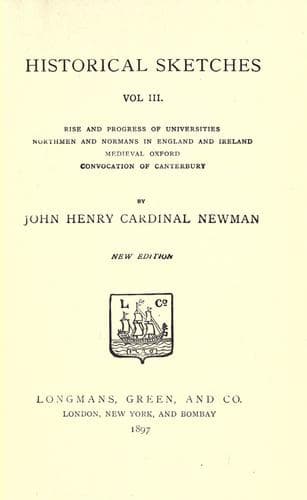
Historical Sketches, Volume I (of 3): The Turks in Their Relation to Europe; Marcus Tullius Cicero; Apollonius of Tyana; Primitive ChristianityNewman, John Henry
HistoryHistory
Historical Sketches, Volume I (of 3): The Turks in Their Relation to Europe; Marcus Tullius Cicero; Apollonius of Tyana; Primitive Christianity
Newman, John Henry
Apollonius, of Tyana; Church history -- Primitive and early church, ca. 30-600; Cicero, Marcus Tullius; Turkey -- History
uninteresting because they are familiar, he may pause or digress before
the mind is weary and the attention begins to flag; the reader is
carried on by easy journeys and short stages, and novelty in the speaker
supplies the want of novelty in the matter. Nor does Cicero discover
less skill in the execution of these dialogues than address in their
method. It were idle to enlarge upon the beauty, richness, and taste of
compositions which have been the admiration of every age and country. In
the dignity of his speakers, their high tone of mutual courtesy, the
harmony of his groups, and the delicate relief of his contrasts, he is
inimitable. The majesty and splendour of his introductions, which
generally address themselves to the passions or the imagination, the
eloquence with which both sides of a question are successively
displayed, the clearness and terseness of his statements on abstract
points, the grace of his illustrations, his exquisite allusions to the
scene or time of the supposed conversation, his digressions in praise of
philosophy or great men, his quotations from Grecian and Roman poetry;
lastly, the melody and fulness of his style, unite to throw a charm
round his writings peculiar to themselves. To the Roman reader they
especially recommended themselves by their continual and most artful
references to the heroes of the old republic, who now appeared but
exemplars, and (as it were) patrons of that eternal philosophy, which he
had before, perhaps, considered as the short-lived reveries of ingenious
but inactive men. Nor is there any confusion, want of keeping, or
appearance of effort in the introduction of the various beauties we have
been enumerating, which are blended together with so much skill and
propriety, that it is sometimes difficult to point out the particular
sources of the admiration which they inspire.
9.
The series of his rhetorical works[201] has been preserved nearly
complete, and consists of the _De Inventione_, _De Oratore_, _Brutus
sive de claris Oratoribus_, _Orator sive de optimo genere Dicendi_, _De
partitione Oratoria_, _Topica_, and _de optimo genere Oratorum_. The
last-mentioned, which is a fragment, is understood to have been the
proem to his translation (now lost) of the speeches of Demosthenes and
AEschines, _De Corona_. These he translated with the view of defending,
by the example of the Greek orators, his own style of eloquence, which,
as we shall afterwards find, the critics of the day censured as too
Asiatic in its character; and hence the proem, which still survives, is
on the subject of the Attic style of oratory. This composition and his
abstracts of his own orations[202] are his only rhetorical works not
extant, and probably our loss is not very great. The _Treatise on
Rhetoric_, addressed to Herennius, though edited with his works, and
ascribed to him by several of the ancients, is now generally attributed
to Cornificius, or some other writer of the day.
Public-domain text, read in full here on John Shaqi.
Reviews
Reviews
No reviews yet
Be the first to share your thoughts on this work.
Elsewhere in the archive
Join the Discussion
Join the discussion
Sign in to leave a comment or review.
Sign InorCreate an account