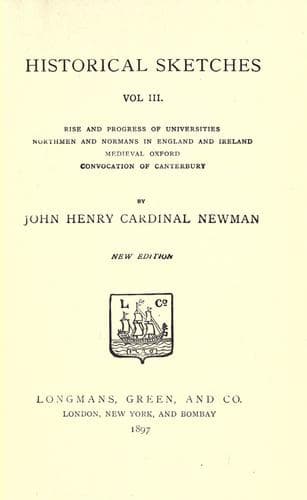
Historical Sketches, Volume I (of 3): The Turks in Their Relation to Europe; Marcus Tullius Cicero; Apollonius of Tyana; Primitive ChristianityNewman, John Henry
HistoryHistory
Historical Sketches, Volume I (of 3): The Turks in Their Relation to Europe; Marcus Tullius Cicero; Apollonius of Tyana; Primitive Christianity
Newman, John Henry
Apollonius, of Tyana; Church history -- Primitive and early church, ca. 30-600; Cicero, Marcus Tullius; Turkey -- History
We might have been inclined, indeed, to suspect that his reputation
existed principally in his biographer's panegyric, were it not attested
by other writers. The celebrity, which he has enjoyed since the writings
of the Eclectics, by itself affords but a faint presumption of his
notoriety before they appeared. Yet, after all allowances, there remains
enough to show that, however fabulous the details of his history may be,
there was something extraordinary in his life and character. Some
foundation there must have been for statements which his eulogists were
able to maintain in the face of those who would have spoken out had they
been altogether novel. Pretensions never before advanced must have
excited the surprise and contempt of the advocates of Christianity.[322]
Yet Eusebius styles him a wise man, and seems to admit the correctness
of Philostratus, except in the miraculous parts of the narrative.[323]
Lactantius does not deny that a statue was erected to him at
Ephesus;[324] and Sidonius Apollinaris, who even wrote his life, speaks
of him as the admiration of the countries he traversed, and the
favourite of monarchs.[325] One of his works was deposited in the palace
at Antium by the Emperor Hadrian, who also formed a collection of his
letters;[326] statues were erected to him in the temples, divine honours
paid him by Caracalla, Alexander Severus, and Aurelian, and magical
virtue attributed to his name.[327]
It has in consequence been made a subject of dispute, how far his
reputation was built upon that supposed claim to extraordinary power
which, as was noticed in the opening of our memoir, has led to his
comparison with Sacred Names. If it could be shown that he did advance
such pretensions, and upon the strength of them was admitted as an
object of divine honour, a case would be made out, not indeed so strong
as that on which Christianity is founded, yet remarkable enough to
demand our serious examination. Assuming, then, or overlooking this
necessary condition, sceptical writers have been forward to urge the
history and character of Apollonius as creating a difficulty in the
argument for Christianity derived from miracles; while their opponents
have sometimes attempted to account for a phenomenon of which they had
not yet ascertained the existence, and have most gratuitously ascribed
his supposed power to the influence of the Evil principle.[328] On
examination, we shall find not a shadow of a reason for supposing that
Apollonius worked miracles in any proper sense of the word; or that he
professed to work them; or that he rested his authority on extraordinary
works of any kind; and it is strange indeed that Christians, with
victory in their hands, should have so mismanaged their cause as to
establish an objection where none existed, and in their haste to
extricate themselves from an imaginary difficulty, to overturn one of
the main arguments for Revealed Religion.
4.
Public-domain text, read in full here on John Shaqi.
Reviews
Reviews
No reviews yet
Be the first to share your thoughts on this work.
Elsewhere in the archive
Join the Discussion
Join the discussion
Sign in to leave a comment or review.
Sign InorCreate an account