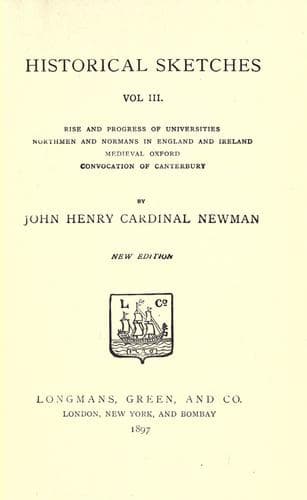
Historical Sketches, Volume I (of 3): The Turks in Their Relation to Europe; Marcus Tullius Cicero; Apollonius of Tyana; Primitive ChristianityNewman, John Henry
HistoryHistory
Historical Sketches, Volume I (of 3): The Turks in Their Relation to Europe; Marcus Tullius Cicero; Apollonius of Tyana; Primitive Christianity
Newman, John Henry
Apollonius, of Tyana; Church history -- Primitive and early church, ca. 30-600; Cicero, Marcus Tullius; Turkey -- History
That wretchedness is found, not in Asia Minor only, but wherever Turks
are to be found in power. Throughout the whole extent of their
territory, if you believe the report of travellers, the peasantry are
indigent, oppressed, and wretched.[54] The great island of Crete or
Candia would maintain four times its present population; once it had a
hundred cities; many of its towns, which were densely populous, are now
obscure villages. Under the Venetians it used to export corn largely;
now it imports it. As to Cyprus, from holding a million of inhabitants,
it now has only 30,000. Its climate was that of a perpetual spring; now
it is unwholesome and unpleasant; its cities and towns nearly touched
one another, now they are simply ruins. Corn, wine, oil, sugar, and the
metals are among its productions; the soil is still exceedingly rich;
but now, according to Dr. Clarke, in that "paradise of the Levant,
agriculture is neglected, inhabitants are oppressed, population is
destroyed." Cross over to the continent, and survey Syria and its
neighbouring cities; at this day the Turks themselves are dying out;
Diarbekr, which numbered 400,000 souls in the middle of last century,
forty years afterwards had dwindled to 50,000. Mosul had lost half its
inhabitants; Bagdad had fallen from 130,000 to 20,000; and Bassora from
100,000 to 8,000.
If we pass on to Egypt, the tale is still the same. "In the fifteenth
century," says Mr. Alison, "Egypt, after all the revolutions which it
had undergone, was comparatively rich and populous; but since the fatal
era of Turkish conquest, the tyranny of the Pashas has expelled
industry, riches, and the arts." Stretch across the width of Africa to
Barbary, wherever there is a Turk, there is desolation. What indeed have
the shepherds of the desert, in the most ambitious effort of their
civilization, to do with the cultivation of the soil? "That fertile
territory," says Robertson, "which sustained the Roman Empire, still
lies in a great measure uncultivated; and that province, which Victor
called _Speciositas totius terrae florentis_, is now the retreat of
pirates and banditti."
Public-domain text, read in full here on John Shaqi.
Reviews
Reviews
No reviews yet
Be the first to share your thoughts on this work.
Elsewhere in the archive
Join the Discussion
Join the discussion
Sign in to leave a comment or review.
Sign InorCreate an account