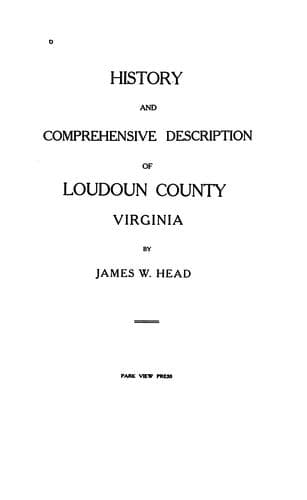
History and Comprehensive Description of Loudoun County, VirginiaHead, James William
History
History and Comprehensive Description of Loudoun County, Virginia
Head, James William
Loudoun County (Va.) -- History
At home or in the ranks, throughout this trying period of civil
strife, her people, with no notable exceptions, remained liberal and
brave and constant, albeit they probably suffered more real hardships
and deprivations than any other community of like size in the
Southland. There were few Confederate troops for its defense, and the
Federals held each neighborhood responsible for all attacks made in
its vicinity, often destroying private property as a punishment.
Both armies, prompted either by fancied military necessity or malice,
burned or confiscated valuable forage crops and other stores, and
nearly every locality, at one time or another, witnessed depredation,
robbery, murder, arson, and rapine. Several towns were shelled,
sacked, and burned, but the worst damage was done the country
districts by raiding parties of Federals. Much of the destruction is
now seen to have been unnecessary from a military point of view.
Whole armies were subsisted on the products of Loudoun's fruitful
acres. Opposing forces, sometimes only detachments and roving bands,
but quite as often battalions, regiments, brigades, and even whole
divisions were never absent from the County and the clash of swords
and fire of musketry were an ever-present clamor and one to which
Loudoun ears early became accustomed.
Also, there were times when the main bodies of one or the other of
both armies were encamped wholly or in part within her limits, as in
September, 1862, when the triumphant army of Lee, on the eve of the
first Maryland campaign, was halted at Leesburg and stripped of all
superfluous transportation, broken-down horses, and wagons and
batteries not supplied with good horses being left behind;[30] again,
in June, 1863, when Hooker was being held in bounds with his great
army stretched from Manassas, near Bull Run, to Leesburg, near the
Potomac; and yet again, in July, 1863, when Lee's army, falling back
from Maryland after the battle of Gettysburg, was followed by the
Federal forces under General Meade, who crossed the Potomac and
advanced through Loudoun.
[Footnote 30: On the 5th day of September, to the martial strains of
"Maryland, My Maryland" from every band in the army, and with his men
cheering and shouting with delight, Jackson forded the Potomac at
Edwards' Ferry (Loudoun County), where the river was broad but
shallow, near the scene of Evan's victory over the Federals in the
previous October, and where Wayne had crossed his Pennsylvania brigade
in marching to the field of Yorktown, in 1781.]
General Early, after the short and bloody battle of Monocacy, and
following his invasion of Maryland and demonstration against
Washington, recrossed the Potomac at White's Ford, July 14, 1864, and,
resting near Leesburg, on the 16th marched to the Shenandoah valley by
way of Leesburg and Purcellville, through Snicker's Gap of the Blue
Ridge, with Jackson's Cavalry in advance.
Public-domain text, read in full here on John Shaqi.
Reviews
Reviews
No reviews yet
Be the first to share your thoughts on this work.
Elsewhere in the archive
Join the Discussion
Join the discussion
Sign in to leave a comment or review.
Sign InorCreate an account