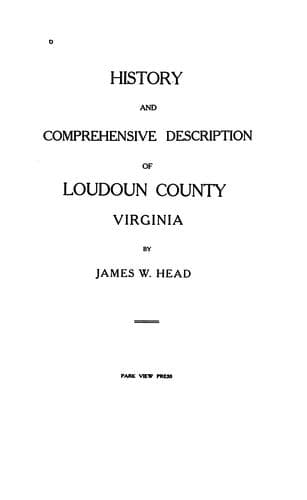
History and Comprehensive Description of Loudoun County, VirginiaHead, James William
History
History and Comprehensive Description of Loudoun County, Virginia
Head, James William
Loudoun County (Va.) -- History
"In the meantime the enemy pressed heavily on Lieutenant Walton. He
had repulsed two mounted charges, but being outflanked by dismounted
men, had been withdrawn about fifty yards behind a house and orchard,
in which position he commanded the only opening through which the
enemy could attack. Here three distinct charges were met and repulsed
in counter-charges by the 5th Virginia Cavalry, by the 3d squadron of
the 4th regiment, led by Lieut. A.D. Payne, and by the 2d and 5th
squadrons of the same regiment, led by Capt. W.B. Newton. These were
the only squadrons of this regiment present at this battle, the 1st
and 4th squadrons having been detailed early in the day to accompany
General Stuart. In each of these charges the enemy had suffered
severely at the hands of Lieutenant Walton's sharpshooters, who poured
volleys into their flanks as they passed him in advancing and
retiring.
"As Walton's party was, however, evidently small, the enemy determined
to dislodge him, and was preparing a considerable force for another
attack, when the 2d and 3d Virginia Cavalry reached the field. Two
squadrons of sharpshooters were at once dismounted and placed on the
left of the road--the squadron from the 2d regiment under Captains
Breckinridge and Graves, that from the 3d regiment under Capt. George
D. White. Their line was advanced to the stone wall from which
Lieutenant Walton had been withdrawn. Colonel Munford now felt that
his position was secure against an attack of cavalry, and there was
nothing he more desired than that the enemy should wear himself out
against it. His flanks were secured by Little River and its
tributaries. The enemy must necessarily attack his front. The road by
which it was approached was worn, as it ascended the hill, into deep
gullies, which compelled an attack in column of fours and prevented
the enemy from spreading out his front. Munford's strong party of
sharpshooters commanded the road. They were stationed in an enclosed
field, with a stone wall in their front, a post and rail fence on
their right, and another fence on their left. The fences to the rear
were thrown down, so as to give the cavalry access to the field.
Munford felt that unless his cavalry failed in their duty, his
dismounted men were perfectly secure.
Public-domain text, read in full here on John Shaqi.
Reviews
Reviews
No reviews yet
Be the first to share your thoughts on this work.
Elsewhere in the archive
Join the Discussion
Join the discussion
Sign in to leave a comment or review.
Sign InorCreate an account