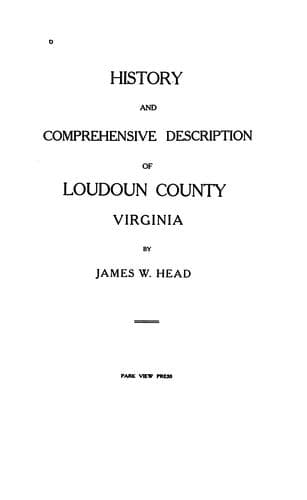
History and Comprehensive Description of Loudoun County, VirginiaHead, James William
History
History and Comprehensive Description of Loudoun County, Virginia
Head, James William
Loudoun County (Va.) -- History
"From Monday afternoon, November 28th, until Friday morning, December
2nd, they ranged through the beautiful Valley of Loudoun and a portion
of Fauquier county, burning and laying waste. They robbed the people
of everything they could destroy or carry off--horses, cows, cattle,
sheep, hogs, etc.; killing poultry, insulting women, pillaging houses,
and in many cases robbing even the poor negroes.
"They burned all the mills and factories, as well as hay, wheat, corn,
straw, and every description of forage. Barns and stables, whether
full or empty, were burned.
"At Mrs. Fletcher's (a widow), where the hogs had been killed for her
winter's supply of meat, the soldiers made a pile of rails upon which
the hogs were placed and burned. They even went to the Poor House and
burned and destroyed the supplies provided for the helpless and
dependent paupers. On various previous occasions, however, the Alms
House had been visited by raiding parties, so that at this time there
was but little left, but of that little the larger portion was taken.
[Footnote 39: _Mosby's Rangers_, by James J. Williamson.]
"Colonel Mosby did not call the command together, therefore there was
no organized resistance, but Rangers managed to save a great deal of
live stock for the farmers by driving it off to places of safety."
_Home Life During the War._
In Loudoun, as everywhere in every age, the seriousness of war was not
fully realized until the volunteer soldiery, following a short season
of feverish social gayety, interspersed with dress parades and
exhibition drills, had departed for their respective posts.
Immediately and with one accord those left behind settled themselves
to watch and wait and work and pray for the absent ones and the cause
they had so readily championed.
When few slaves were owned by a family the white boys, too young for
service in the army, worked with them in the fields, while the girls
busied themselves with household duties, though, at times, they, too,
labored in the open. In families owning no slaves the old men,
cripples, women, and children were forced to shoulder the arduous
labors of the farm.
Stern necessity had leveled sexual and worldly distinctions, and
manual labor was, at times, performed by all who were in the least
physically fitted for it. All classes early became inured to
makeshifts and privations, though they managed in some unselfish
manner to send, from time to time, great quantities of clothing,
meats, and other supplies to the soldiers in the field and their
wounded comrades in the army hospitals.
The intense devotion of Loudoun women to the Confederate cause was
most irritating to a certain class of Federal officers in the armies
that invaded Northern Virginia. They seemed to think that through
their military prowess they had conquered entrance into Southern
society, but the women repulsed them at every turn and quite
effectually checked their presumptuous advances.
Public-domain text, read in full here on John Shaqi.
Reviews
Reviews
No reviews yet
Be the first to share your thoughts on this work.
Elsewhere in the archive
Join the Discussion
Join the discussion
Sign in to leave a comment or review.
Sign InorCreate an account