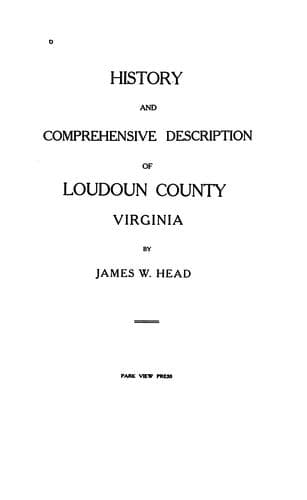
History and Comprehensive Description of Loudoun County, VirginiaHead, James William
History
History and Comprehensive Description of Loudoun County, Virginia
Head, James William
Loudoun County (Va.) -- History
The early settlers, with but one class exception, had no costly tastes
to gratify, no expensive habits to indulge, and neither possessed nor
cared for luxuries. Their subsistence, such as they required, cost but
little of either time or labor. The corn from which they made their
bread came forth from the prolific soil almost at the touch of their
rude plows. Their cattle and hogs found abundant sustenance in the
broad pastures which, in the summer, yielded the richest grass, and in
the woods where, in the fall, the ground was strewn with acorns and
other like provender.
The pioneer lived roughly; the German from the Palatinate kept house
like the true peasant that he was; the planter lived somewhat more
sumptuously and luxuriously; but, in nearly every case, the table was
liberally supplied. Hominy, milk, corn-bread, and smoked or jerked
meats seem to have been most popular with the humbler classes.
Ice was not stored for summer use, fruits were few and not choice, and
the vegetables limited; our ancestors, at that time, having no
acquaintance with the tomato, cauliflower, egg-plant, red-pepper,
okra, and certain other staple vegetables of today. The Indians had
schooled them in the preparation of succotash with the beans grown
among the corn, and they raised melons, squashes, and pumpkins in
abundance.
Corn for bread was broken in a mortar and ground in a grater or
hand-mill. Mills, in the early days, were few and far apart, some of
the back-settlers being compelled to travel many miles for their
grist. This condition gave origin to the adage "first come first
served," and frequently carried the late arrivals over night and, at
times, prolonged the trip to procure a few bushels of meal three or
four days. "Band-mills," run by horses, and small water mills, where
the situation permitted, came into use to supply the demand of larger
ones. The building of a good mill, it must be confessed, was hailed
with greater satisfaction than the erection of a church.
The more primitive of these peoples ate from wooden trenchers and
platters; sat upon three-legged stools or wooden blocks; used bear's
grease in lieu of lard and butter, and cut their foods with the same
sheath-knives used in disembowelling and skinning the deer killed by
their rifles. They had no money and their scant furniture was
essentially crude, sometimes including a few pewter dishes and plates
and spoons, but usually nothing beyond wooden bowls, trenchers, and
noggins, with gourds and squashes daintily cut. The horse trough
served as a wash-basin, and water buckets were seldom seen. The family
owning an iron pot and a kitchen table were esteemed rich and
extravagant, and china and crockery ware were at once practically
unknown and uncraved. Feather-beds and bedsteads were equally
eschewed, these hardy men who had conquered the wilderness not
disdaining, when night came, to sleep upon a dirt floor with a
bear-skin for covering.
Public-domain text, read in full here on John Shaqi.
Reviews
Reviews
No reviews yet
Be the first to share your thoughts on this work.
Elsewhere in the archive
Join the Discussion
Join the discussion
Sign in to leave a comment or review.
Sign InorCreate an account