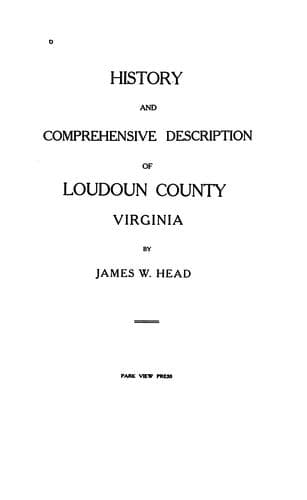
History and Comprehensive Description of Loudoun County, VirginiaHead, James William
History
History and Comprehensive Description of Loudoun County, Virginia
Head, James William
Loudoun County (Va.) -- History
While a large proportion of the home-seekers that had settled in the
County immediately after the Revolution had received a rudimentary
education, and had lived among communities which may be said to have
been comparatively cultured, most of them were hardy, rough,
uncultivated back-woodsmen, accustomed only to the ways of the
frontier and camp. Many of them had served in the war of the
Revolution and all of them in the border wars with the Indians. Though
brave, hospitable and generous, they were more at ease beneath the
forest bivouac than in the "living-room" of the log-cabin, and to
swing a woodman's axe among the lofty trees of the primeval forest was
a pursuit far more congenial to their rough nature and active
temperament than to mingle with society in settled communities. Their
habits and manners were plain, simple, and unostentatious. Their
clothing was generally made of the dressed skins of the deer, wolf, or
fox, while those of the buffalo and elk supplied them with covering
for their feet and heads. Their log-cabins were destitute of glass,
nails, hinges, or locks.
Education during the early settlements received but little attention
in Loudoun, and school-houses, always of logs, were scarcely to be
seen. Schools were sometimes opened at private houses or at the
residence of the teacher; but "book larnin" was considered too
impracticable to be of much value.
While the standard of morality, commercial as well as social, was of a
high order, few of these settlers were members of any church. Many of
them, however, had been reared in religious communities by Christian
parents; had been taught to regard the Sabbath as a day of worship,
and had been early impressed with a sense of the necessity of
religious faith and practice. Some of the prominent citizens
encouraged these views by occasionally holding meetings in their
cabins, at which the scriptures and sometimes sermons were read and
hymns sung, but no prayers were offered. The restraining and molding
influence of these early Christian efforts upon the habits and morals
of the people was in every respect wholesome and beneficial. The
attention of the people was arrested and turned to the study and
investigation of moral and religious questions, and direction was
given to the contemplation of higher thoughts and the pursuit of a
better life.
Public-domain text, read in full here on John Shaqi.
Reviews
Reviews
No reviews yet
Be the first to share your thoughts on this work.
Elsewhere in the archive
Join the Discussion
Join the discussion
Sign in to leave a comment or review.
Sign InorCreate an account