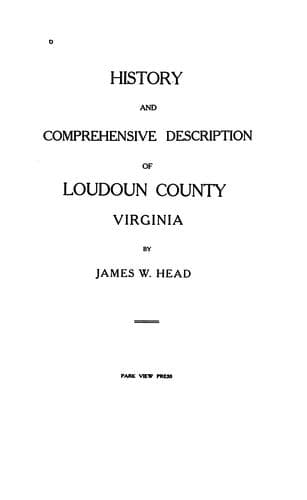
History and Comprehensive Description of Loudoun County, VirginiaHead, James William
History
History and Comprehensive Description of Loudoun County, Virginia
Head, James William
Loudoun County (Va.) -- History
The substantial planter and burgher dressed well but were not so
particular about their wigs, of which they probably owned no more than
one, kept for visiting and for Sabbath use. They usually yielded to
the custom of shaving their heads, however, and wore white linen caps
under their hats. During the Revolutionary War wigs were scare and
costly, linen was almost unobtainable and the practice of shaving
heads accordingly fell rapidly into desuetude. Sometimes the burgher's
hat was of wool or felt, with a low crown and broad brim, turned up
and cocked. About his neck he wore a white linen stock, fastening with
a buckle at the back. His coat was of cloth, broad-backed, with
flap-pockets, and his waist-coat, of the same stuff, extended to his
knees. He wore short breeches with brass or silver knee-buckles, red
or blue garters, and rather stout, coarse leather shoes, strapped over
the quarter. He wore no sword, but often carried a staff, and knew how
to use it to advantage.
Mechanics, laborers and servants wore leather-breeches and aprons,
sagathy coats, osnaburg shirts and hair-shag jackets, coarse shoes,
and worsted or jean stockings, knit at home.
The dress of the women of these classes was shabbier still, their
costumes, for the most part, comprising stamped cotton and white
dimity gowns, coarse shift (osnaburg), country cloth, and black
quilted petticoats. In the backwoods and the primitive German
settlements the women all wore the short gowns and petticoats, also
tight-fitting calico caps. In summer, when employed in the fields,
they wore only a linen shift and a petticoat of home-made linsey. All
their clothing, in fact, was home-made.
The ladies of quality, however, as has been intimated, dressed
extravagantly, frizzed, rouged, wore trains, and acted as fashionable
women have done from the immemorial beginning of things.
The pioneers dressed universally in the hunting shirt or blouse,
sometimes fringed and decorated, and perhaps the most convenient frock
ever conceived. It fit loosely, was open in front, reached almost to
the knees, and had large sleeves, and a cape for the protection of the
shoulders in bad weather. In the ample bosom of this shirt the hunter
carried his bread and meat, the tow with which to wipe out the barrel
of his rifle, and other small requisites. To his belt, tied or buckled
behind, he suspended his mittens, bullet-pouch, tomahawk, and knife
and sheath. His hunting-shirt was made of dressed deer-skin--very
uncomfortable in wet weather--or of linsey, when it was to be had. The
pioneer dressed his lower body in drawers and leathern cloth leggins,
and his feet in moccasins; a coon-skin cap completing the attire.
Public-domain text, read in full here on John Shaqi.
Reviews
Reviews
No reviews yet
Be the first to share your thoughts on this work.
Elsewhere in the archive
Join the Discussion
Join the discussion
Sign in to leave a comment or review.
Sign InorCreate an account