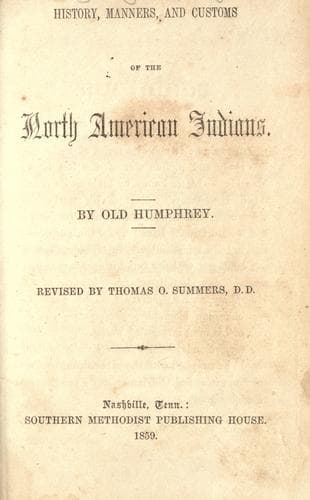
History, Manners, and Customs of the North American IndiansOld Humphrey
History
History, Manners, and Customs of the North American Indians
Old Humphrey
Indians of North America
_Hunter._ It has pleased God to endue Indians with quick perceptions.
They are amazingly quick in tracing an enemy, both in the woods and
the prairie. A broken twig or leaf, or the faintest impression on the
grass, is sufficient to attract their attention. The anecdotes I am
about to relate are believed to be true, but I cannot myself vouch for
their correctness, having only read them, or heard them related by
others.
An Indian, upon his return home to his hut one day, discovered that
his venison, which had been hung up to dry, had been stolen. After
going some distance, he met some persons, of whom he inquired if they
had seen a _little, old, white man_, with a short gun, and accompanied
by a small dog with a bob-tail. They replied in the affirmative; and,
upon the Indian's assuring them that the man thus described had stolen
his venison, they desired to be informed how he was able to give such
a minute description of a person whom he had not seen. The Indian
answered thus:--
"The thief I know is a _little_ man, by his having made a pile of
stones in order to reach the venison, from the height I hung it
standing on the ground; that he is an _old_ man, I know by his short
steps, which I have traced over the dead leaves in the woods; that he
is a _white_ man, I know by his turning out his toes when he walks,
which an Indian never does; his gun I know to be short, by the mark
which the muzzle made by rubbing the bark of the tree on which it
leaned; that the dog is small, I know by his tracks; and that he has a
bob-tail, I discovered by the mark of it in the dust where he was
sitting at the time his master was taking down the meat."
_Brian._ Well done, Indian! Why, nothing could escape a man like
that.
_Austin._ An Englishman would hardly have been able to describe the
thief without seeing him.
_Hunter._ You shall have another instance of the quick perceptions of
the red men. A most atrocious and shocking murder was once committed,
by a party of Indians, on fourteen white settlers, within five miles
of Shamokin. The surviving whites, in their rage, determined to take
their revenge by murdering a Delaware Indian, who happened to be in
those parts, and who was far from thinking himself in any danger. He
was a great friend to the whites, was loved and esteemed by them, and,
in testimony of their regard, had received from them the name of Duke
Holland, by which he was generally known.
This Indian, satisfied that his nation were incapable of committing
such a foul murder in a time of profound peace, told the enraged
settlers that he was sure the Delawares were not in any manner
concerned in it, and that it was the act of some wicked Mingoes or
Iroquois, whose custom it was to involve other nations in wars with
each other, by secretly committing murders, so that they might appear
to be the work of others. But all his representations were vain; he
could not convince exasperated men, whose minds were fully bent on
revenge.
Public-domain text, read in full here on John Shaqi.
Reviews
Reviews
No reviews yet
Be the first to share your thoughts on this work.
Elsewhere in the archive
Join the Discussion
Join the discussion
Sign in to leave a comment or review.
Sign InorCreate an account