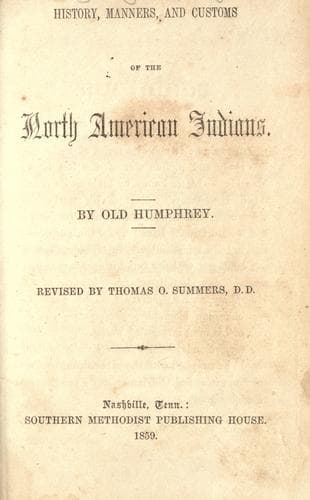
History, Manners, and Customs of the North American IndiansOld Humphrey
History
History, Manners, and Customs of the North American Indians
Old Humphrey
Indians of North America
_Hunter._ No doubt they would; but Indians have good and bad
qualities. The notion entertained by the Iroquois Indians, respecting
the creation of mankind, will show how ignorant they are with respect
to the Creator of all things; but, indeed, if the blessed book of
truth were not in our hands, we should be equally ignorant ourselves.
Before man existed, say they, there were three great and good spirits;
of whom one was superior to the other two, and is emphatically called
the Great Spirit and the Good Spirit. At a certain time, this exalted
being said to one of the others, "Make a man." He obeyed; and, taking
chalk, formed a paste of it, and moulding it into the human form,
infused into it the animating principle, and brought it to the Great
Spirit. He, after surveying it, said, "This is too white."
He then directed the other to make a trial of his skill. Accordingly,
taking charcoal, he pursued the same process, and brought the result
to the Great Spirit; who, after surveying it, said, "It is too black."
Then said the Great Spirit, "I will now try myself;" and taking red
earth, he formed an Indian. On surveying it, he said, "This is a
proper or perfect man."
After relating the strange opinion of the Iroquois Indians, the hunter
advised the young people, on their return home, to look over the
account of the creation of the world and mankind, in the first chapter
of Genesis; telling them that they could not be too thankful for the
opportunity of reading God's word, which was not only sufficient to
keep them from error in such things, but was able also to make them
"wise unto salvation through faith which is in Christ Jesus." He told
them, that though the Indians were ignorant of holy things, they did
not want shrewdness and sagacity. "When General Lincoln," said he,
"went to make peace with the Creek Indians, one of the chiefs asked
him to sit down on a log; he was then desired to move, and, in a few
minutes, to move still farther. The request was repeated, until the
general got to the end of the log. The Indian still said, 'Move
farther;' to which the general replied, 'I can move no farther.'
'Just so it is with us,' said the chief. 'You have moved us back to
the water, and then ask us to move farther!'"
In the account of his expedition to the foot of the Rocky Mountains,
in 1821, Major Long relates the following anecdote of a Pawnee brave,
son of Red Knife, who, in the succeeding winter, visited the city of
Washington, during the session of Congress.
This brave, of fine size, figure and countenance, is now about
twenty-five years old. At the age of twenty-one, his heroic deeds had
acquired for him in his nation the rank of the bravest of the braves.
The savage practice of torturing and burning to death their prisoners
existed in this nation. An unfortunate female, of the Paduca nation,
taken in war, was destined to this horrid death.
Public-domain text, read in full here on John Shaqi.
Reviews
Reviews
No reviews yet
Be the first to share your thoughts on this work.
Elsewhere in the archive
Join the Discussion
Join the discussion
Sign in to leave a comment or review.
Sign InorCreate an account