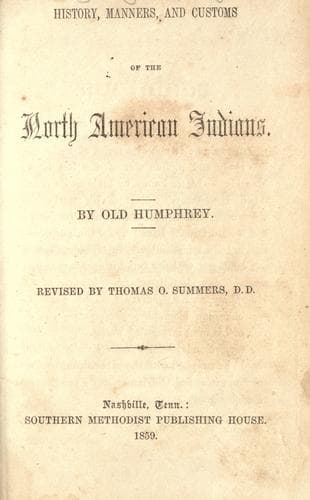
History, Manners, and Customs of the North American IndiansOld Humphrey
History
History, Manners, and Customs of the North American Indians
Old Humphrey
Indians of North America
Never, sure, did young people make a more grotesque appearance, than
did Austin, Brian, and Basil Edwards, in their attempt to get up a
buffalo dance. Each had a mat over his shoulders, and a brown paper
mask over his face; two wooden pegs on a string made a very
respectable pair of horns; bows and arrows were in abundance; a toy
rattle and drum, with the addition of an iron spoon and a wooden
trencher, supplied them with music; and neither Mandan, Pawnee, Crow,
Sioux, Blackfoot, nor Camanchee, could have reasonably complained of
the want of either noise or confusion.
Then, again, they were very successful in bringing buffaloes, without
which the dance, excellent as it was, would have been but an
unsatisfactory affair. Black Tom had been prudently shut up in the
tool-house, and Jowler tied up to a tree hard by, so that, when it
became expedient for buffaloes to appear, the house of Black Tom was
opened, and Jowler was set at liberty. All things considered, the
affair went off remarkably well.
"We are come to hear of the bear dance, and the dog dance, and the
beggars' dance, and the green corn dance," said Austin to the hunter,
on the following day, when a visit was paid to the cottage. The
hunter, with his accustomed kindness to the young people, lost no time
in entering on his narrative. "You must not forget," said he, "that
many of the dances of the Indians partake of a religious character,
for in them reverence and adoration are freely offered. The Indians'
worship of the Great Spirit, as I have already told you, is mingled
with much of ignorance and superstition, whether in dances or in other
observances; yet do they, at times, leave upon the mind of a spectator
a deep impression of their sincerity, though this does not excuse
their error. I have not as yet described their music, and therefore
will do it now."
_Austin._ Yes. Now for the music of the Indians, if you please, sir.
_Hunter._ If you ever go among them, and mingle in their dances, you
must not expect to have a band of music such as you have in our
cities. Whistles, flutes, rattles and drums are almost all their
musical instruments. You would be surprised at the music that some of
the young Indians produce with the mystery whistle.
_Austin._ Why is it called the mystery whistle?
_Hunter._ I have already told you that the red man calls every thing
mystery, or medicine, that is surprising; and as the notes of this
whistle are particularly sweet, it may be called a mystery whistle on
this account. There is another whistle that is very much in request
among the Indians, and that is the war whistle. The onset and the
retreat in battle are sounded on this instrument by the leading chief,
who never goes on an expedition without it. It is made of bone, and
sometimes it is formed of the leg bone of a large bird. The shrill,
scream-like note, which is the signal for rushing on an enemy, would
make you start.
_Brian._ What sort of a drum do they use? Is it a kettle-drum?
Public-domain text, read in full here on John Shaqi.
Reviews
Reviews
No reviews yet
Be the first to share your thoughts on this work.
Elsewhere in the archive
Join the Discussion
Join the discussion
Sign in to leave a comment or review.
Sign InorCreate an account