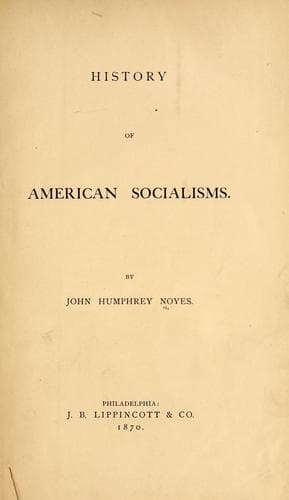
History of American SocialismsNoyes, John Humphrey
History
History of American Socialisms
Noyes, John Humphrey
Communism -- United States; Socialism -- United States
What is there in all this that entitles St. Simon to a place among the
theoretico-practicals? How does it appear that he "combined the
enunciation of general principles of social organization with actual
experiments?" His followers tried to do something; but St. Simon
himself, according to this account, did absolutely nothing but write
and talk; and far from being a theoretico-practical, was not even
theoretical, but only sentimental!
Fourier was theoretical enough. But we look in vain through Mr.
Godwin's account of him for any signs of the practical. He meditated
much and wrote many books, and that is all. He was a student and a
recluse to the end of his career. Instead of engaging in any practical
attempt to realize his social theories, he quarreled with the only
experiment that was made by his disciples during his life. Godwin
says:
"A joint-stock company was formed in 1832, to realize the new
theory of Association; and one gentleman, M. Baudet Dulary,
member of parliament for the county of Seine and Oise, bought an
estate, which cost him five hundred thousand francs (one hundred
thousand dollars), for the express purpose of putting the theory
into practice. Operations were actually commenced; but for want
of sufficient capital to erect buildings and stock the farm, the
whole operation was paralyzed; and notwithstanding the natural
cause of cessation, the simple fact of stopping short after
having commenced operations, made a very unfavorable impression
upon the public mind. Success is the only criterion with the
indolent and indifferent, who do not take the trouble to reason
on circumstances and accidental difficulties.
"Fourier was very much vexed at the precipitation of his
partisans, who were too impatient to wait until sufficient means
had been obtained. They argued that the fact of having commenced
operations would attract the attention of capitalists, and
insure the necessary funds. He begged them to beware of
precipitation; told them how he had been deceived himself in
having to wait more than twenty years for a simple hearing,
which, from the importance of his discovery, he had fully
expected to obtain immediately. All his entreaties were in vain.
They told him he had not obtained a hearing sooner because he
was not accustomed to the duplicity of the world; and confident
in their own judgment, commenced without hesitation, and were
taught, at the expense of their own imprudence, to appreciate
more correctly the sluggish indifference of an ignorant public."
Public-domain text, read in full here on John Shaqi.
Reviews
Reviews
No reviews yet
Be the first to share your thoughts on this work.
Elsewhere in the archive
Join the Discussion
Join the discussion
Sign in to leave a comment or review.
Sign InorCreate an account