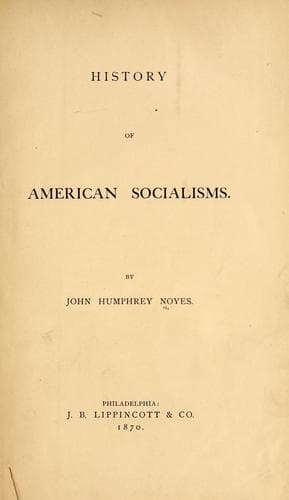
History of American SocialismsNoyes, John Humphrey
History
History of American Socialisms
Noyes, John Humphrey
Communism -- United States; Socialism -- United States
After this address, Mr. Ripley of Brook Farm made a speech, and Mr.
Solyman Brown of the Leraysville Phalanx recited "a very beautiful
pastoral, entitled, A Vision of the Future." Here occurred a little
episode that brought our old friends of the Owenite wing of Socialism
on the scene; not, however, altogether harmonically. The report says:
"A delegation of English Socialists, from a society in this city,
presented itself. The gentlemen composing the delegation, demanded
seats as members of the Convention. The call of the Convention was
read, and they were asked if they could unite with the Convention
according to the terms of the call, as 'friends of Association based
on the principles of Charles Fourier.' This they said they could not
do, as they differed with the partisans of Fourier in fundamental
principles, and particularly in regard to religion and property. They
held to community of property, and did not accept our views of a
Providential and Divine social order. They were informed that the
objects of the Convention were of a special and business character,
and that a controversy and discussion of principles could not be
entered into. Their claim to sit as members of the Convention was
therefore denied: but they were allowed freely to express their
opinions, and treated with the utmost courtesy, without reply."
Many "admirable addresses" continued to be delivered; among which one
of Mr. Channing's is mentioned, and one of Charles A. Dana's is
reported in full. He spoke as the representative of Brook Farm. We
cull a few broken paragraphs:
"As a member of the oldest Association in the United States, I deem it
my duty to make some remarks on the practical results of the system.
We have an Association at Brook Farm, of which I now speak from my own
experience. We have there abolished domestic servitude. This
institution of domestic servitude was one of the first considerations;
it gave one of the first impulses to the movement at Brook Farm. It
seemed that a continuance in the relations which it established, could
not possibly be submitted to. It was a deadly sin--a thing to be
escaped from. Accordingly it was escaped from, and we have now for
three years lived at Brook Farm and have carried on all the business
of life without it. At Brook Farm they are all servants of each other;
no man is master. We do freely, from the love of it, with joy and
thankfulness, those duties which are usually discharged by domestics.
The man who performs one of these duties--he who digs a ditch or
executes any other repulsive work, is not at the foot of the social
scale; he is at the head of it. Again we have in Association
established a natural system of education; a system of education which
does justice to every one; where the children of the poor receive the
integral development of all their faculties, as far as the means of
Association in its present condition will permit. Here we claim to
have made an advance upon civilized society.
Public-domain text, read in full here on John Shaqi.
Reviews
Reviews
No reviews yet
Be the first to share your thoughts on this work.
Elsewhere in the archive
Join the Discussion
Join the discussion
Sign in to leave a comment or review.
Sign InorCreate an account