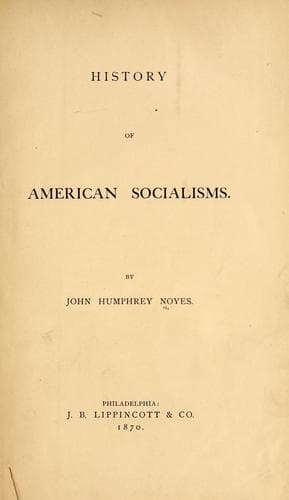
History of American SocialismsNoyes, John Humphrey
History
History of American Socialisms
Noyes, John Humphrey
Communism -- United States; Socialism -- United States
"Our trials lie in the commonest walks. To forego conveniences,
to live poorly, dress homely, to listen calmly, reply mildly,
and wait patiently, are what we must become familiar with. True,
these are requirements by no means uncommon; but imperfect
beings like ourselves are apt to imagine that they alone are
called upon to endure. Yet, perhaps, we enjoy no less than the
most of our sex; nay, we are in truth, sisters the world round;
if one suffers, all suffer, no matter whether she tends her
husband's dogs amidst the Polar snows, or mounts her consort's
funeral pile upon the banks of the Ganges. Together we weep,
together we rejoice. We rise, we fall together.
"It would afford us much pleasure could we be associated
together. Could all the women fitted to engage in Social Reform
be located on one domain, one can not imagine the immense
changes that would ensue. We pray that we, or at least our
children, may live to see the day when kindred souls shall be
permitted to cooperate in a sphere sufficiently extensive to
call forth all our powers."
(From a letter of N.C. Meeker, August 11, 1847.)
"Our progress and prosperity are still continued. By this we
only mean that whatever we secure is by overcoming many
difficulties. Our triumphs, humble though they be, are achieved
in the same manner that the poet or the sculptor or the chemist
achieves his, by labor, by application; and we believe that to
produce the most useful and beautiful things, the most labor and
pains are necessary.
"Our present difficulties are, first, want of a sufficient
number to enable us to establish independent groups, as Fourier
has laid down. The present arrangement is as though we were all
in one group; what is earned by the body is divided among
individuals according to the amount of labor expended by each.
Were our branches of business fewer (for we carry on almost
every branch of industry necessary to support us) we could
organize with less danger of interruption, which at present
must be incessant; yet, at the same time there would be less
choice of employment. Our number is about two hundred and fifty,
and that of laboring men not far from fifty. This want of a
greater number is by no means a serious difficulty; still, one
we wish were corrected by an addition of scientific and
industrious men, with some capital.
Public-domain text, read in full here on John Shaqi.
Reviews
Reviews
No reviews yet
Be the first to share your thoughts on this work.
Elsewhere in the archive
Join the Discussion
Join the discussion
Sign in to leave a comment or review.
Sign InorCreate an account