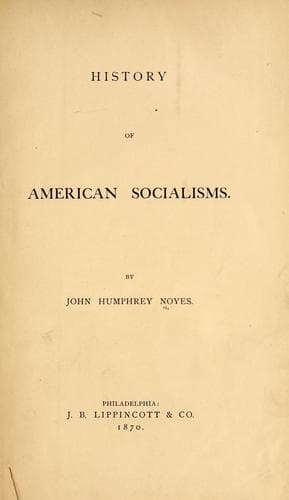
History of American SocialismsNoyes, John Humphrey
History
History of American Socialisms
Noyes, John Humphrey
Communism -- United States; Socialism -- United States
"The Hopedale Community, originally called Fraternal Community,
No. 1, was formed at Mendon, Massachusetts, January 28, 1841, by
about thirty individuals from different parts of the State. In
the course of that year they purchased what was called the
'Jones Farm,' _alias_ 'The Dale,' in Milford. This estate they
named HOPEDALE--joining the word 'Hope' to its ancient
designation, as significant of the great things they hoped for
from a very humble and unpropitious beginning. About the first
of April 1842, a part of the members took possession of their
farm and commenced operations under as many disadvantages as can
well be imagined. Their present domain (December 1, 1851),
including all the lands purchased at different times, contains
about 500 acres. Their village consists of about thirty new
dwelling-houses, three mechanic shops, with water-power,
carpentering and other machinery, a small chapel, used also for
the purposes of education, and the old domicile, with the barns
and out-buildings much improved. There are now at Hopedale some
thirty-six families, besides single persons, youth and children,
making in all a population of about 175 souls.
"It is often asked, What are the peculiarities, and what the
advantages of the Hopedale Community? Its leading peculiarities
are the following:
"1. It is a church of Christ (so far as any human organization
of professed Christians, within a particular locality, have the
right to claim that title), based on a simple declaration of
faith in the religion of Jesus Christ, as he taught and
exemplified it, according to the scriptures of the New
Testament, and of acknowledged subjection to all the moral
obligations of that religion. No person can be a member, who
does not cordially assent to this comprehensive declaration.
Having given sufficient evidence of truthfulness in making such
a profession, each individual is left to judge for him or
herself, with entire freedom, what abstract doctrines are
taught, and also what external religious rites are enjoined in
the religion of Christ. No precise theological dogmas,
ordinances or ceremonies are prescribed or prohibited. In such
matters all the members are free, with mutual love and
toleration, to follow their own highest convictions of truth and
religious duty, answerable only to the great Head of the true
Church Universal. But in practical Christianity this church is
precise and strict. There its essentials are specific. It
insists on supreme love to God and man--that love which 'worketh
no ill' to friend or foe. It enjoins total abstinence from all
God-contemning words and deeds; all unchastity; all intoxicating
beverages; all oath-taking; all slave-holding and pro-slavery
compromises; all war and preparations for war; all capital and
Public-domain text, read in full here on John Shaqi.
Reviews
Reviews
No reviews yet
Be the first to share your thoughts on this work.
Elsewhere in the archive
Join the Discussion
Join the discussion
Sign in to leave a comment or review.
Sign InorCreate an account