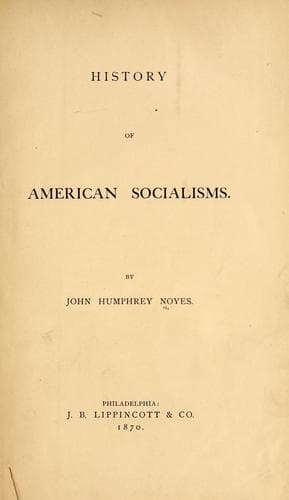
History of American SocialismsNoyes, John Humphrey
History
History of American Socialisms
Noyes, John Humphrey
Communism -- United States; Socialism -- United States
Let it not be thought that Ballou was a mere theorizer. Unlike Owen
and Fourier, he worked as well as wrote. Originally a clergyman and a
gentleman, he gave up his salary, and served in the ranks as a common
laborer for his cause. In conversation with one who reported to us, he
said, that often-times in the early days of Hopedale he would be so
tired at his work in the ditch or on the mill-dam, that he would go to
a neighboring haystack, and lie down on the sunny side of it, wishing
that he might go to sleep and never wake again! Then he would
recuperate and go back to his work. Nearly all the recreation he had
in those days, was to go out occasionally into the neighborhood and
preach a funeral sermon!
And this, by the way, is a fit occasion to say that in our opinion
there ought to be a prohibitory duty on the importation of socialistic
theories, that have not been worked out, as well as written out, by
the inventors themselves. It is certainly cruel to set vast numbers of
simple people agog with Utopian projects that will cost them their
all, while the inventors and promulgators do nothing but write and
talk. What kind of a theory of chemistry can a man write without a
laboratory? What if Napoleon had written out a programme for the
battle of Austerlitz, and then left one of his aids-de-camp to
superintend the actual fighting?
It will be noticed that Mr. Ballou, in his expositions, carries his
assurance that his system is all right, and his confidence of success,
to the verge of presumption. In this he appears to have partaken of a
spirit that is common to all the socialist inventors. Fourier, without
a laboratory or an experiment, was as dogmatic and infallible as
though he were an oracle of God; and Owen, after a hundred defeats,
never doubted the perfection of his scheme, and never fairly confessed
a failure. But in the end Ballou rises above these theorizers, even in
this matter. Our informant says he manfully owns that Hopedale was a
_total_ failure.
As to the causes of the catastrophe, his account is the old story of
general depravity. The timber he got together was not suitable for
building a Community. The men and women that joined him were very
enthusiastic, and commenced with great zeal; their devotion to the
cause seemed to be sincere; but they did not know themselves.
The following details, given by Mr. Ballou, of the actual proceedings
which brought Hopedale to its end, are very instructive in regard to
the operation of the joint-stock principle.
Public-domain text, read in full here on John Shaqi.
Reviews
Reviews
No reviews yet
Be the first to share your thoughts on this work.
Elsewhere in the archive
Join the Discussion
Join the discussion
Sign in to leave a comment or review.
Sign InorCreate an account