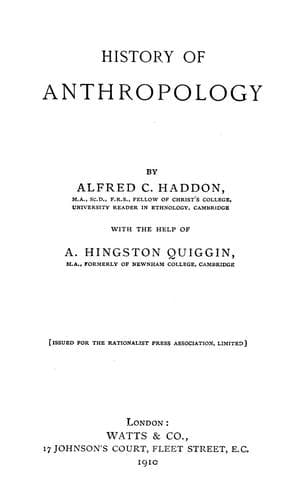
History of anthropologyHaddon, Alfred C. (Alfred Cort)
History
History of anthropology
Haddon, Alfred C. (Alfred Cort)
Anthropology -- History
2. The study of the mind of the individual compared with other minds.
3. The study of the normal mind of the individual compared with the
abnormal.
4. The study of the mind of one race compared with that of other races.
5. The study of the mind of genus Homo compared with that of animals.
All these are of interest and value for Anthropology, especially the
second, fourth, and fifth.
In the earlier days of psychology, when the subject was in the
leading-strings of philosophy, it had little ethnological value. Indeed,
the possibility of such a subject as ethnological psychology was not
realised.
[Sidenote: =Ethnical Psychology.=]
Ethnical psychology, the study of the mind of other races and peoples,
of which, among the more backward races, glimpses can be obtained only
by living among them and endeavouring to reach their point of view by
means of observation and experiment, is a modern conception; and for
this branch of the subject there is no history.
As an illustration of the change of attitude with regard to ethnical
psychology during the last fifty years, we may quote from Burmeister[60]
in 1853: “It is not worth while to look into the soul of the negro. It
is a judgment of God which is being executed that, at the approach of
civilisation, the savage man must perish”; and again,[61] in 1857: “I
have often tried to obtain an insight into the mind of the negro, but it
was never worth the trouble.” Compare with this such works as R. E.
Dennett’s _At the Back of the Black Man’s Mind_, 1906. In justification
of his attempt to represent the basal ideas of the West African native,
Dennett says: “I cannot help feeling that one who has lived so long
among the Africans, and who has acquired a kind of way of thinking
black, should be listened to on the off-chance that a secondary
instinct, developed by long contact with the people he is writing about,
may have driven him to a right, or very nearly right, conclusion” (pp.
133-4). And as the keynote of his elaborate investigation, which results
in “crediting the Africans with thoughts, concerning their religious and
political system, comparable to any that may have been handed down” to
ourselves by our own ancestors, he quotes from Flora L. Shaw[62]: “It
may happen that we shall have to revise entirely our view of the black
races, and regard those who now exist as the decadent representatives of
an almost forgotten era, rather than as the embryonic possibility of an
era yet to come.”
Footnote 60:
_Der Schwarze Mensch._
Footnote 61:
_Reise nach Brasilien._
Footnote 62:
Flora L. Shaw (Lady Lugard), _A Tropical Dependency_, p. 17.
Public-domain text, read in full here on John Shaqi.
Reviews
Reviews
No reviews yet
Be the first to share your thoughts on this work.
Join the Discussion
Join the discussion
Sign in to leave a comment or review.
Sign InorCreate an account