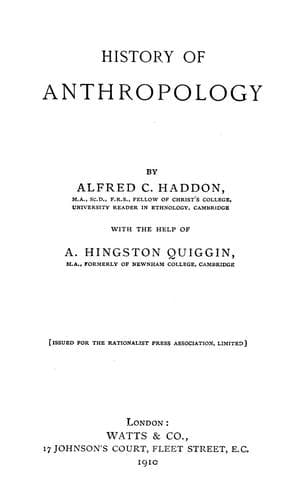
History of anthropologyHaddon, Alfred C. (Alfred Cort)
History
History of anthropology
Haddon, Alfred C. (Alfred Cort)
Anthropology -- History
During the last few years the subject of race improvement, or Eugenics,
has been greatly to the fore, and it has been in this country mainly
connected with the name of Sir Francis Galton, who as long ago as 1865
published his views on the subject. Eugenics is officially defined in
the Minutes of the University of London as “the study of agencies under
social control that may improve or impair the racial qualities of future
generations, either physically or mentally.” A eugenics laboratory has
recently been established in University College, London, in connection
with Professor Karl Pearson’s biometric laboratory.
------------------------------------------------------------------------
CHAPTER VI.
THE CLASSIFICATION AND DISTRIBUTION OF MAN
[Sidenote: =Race Description and Classification.=]
After the age of race discrimination comes the age of race description
and classification; and, as we should expect, this second stage is not
reached until the close of the Dark Ages and the dawn of the
Renaissance, when thought had been emancipated from the bondage of
scholastic authority and stimulated by the new impulse which infected
all forms of intellectual activity.
[Sidenote: =Bernier.=]
The first attempt at the classification of mankind was that of a French
traveller, F. Bernier (1625-1688), whose scheme appeared in an anonymous
article in the _Journal des Scavans_, 1684, entitled “A new division of
the earth, according to the different species or races of men who
inhabit it,” etc.[65]
Footnote 65:
See T. Bendyshe, _Mem. Anth. Soc._, I., 1865, p. 360.
He distinguished “four or five species or races”: (1) The inhabitants of
Europe, North Africa (including the Egyptians), and a great part of Asia
(including the Indians). He notes that the Egyptians and Indians are
black or copper-coloured, but considered the complexion to be due to
climate. (2) The Africans, with thick lips, flat noses, and black skins,
due not to climate but nature, with scanty beard and woolly hair. (3)
The Asiatics not included in the first group, white, with “broad
shoulders, a flat face, a small squab nose, little pig’s-eyes long and
deep-set, and three hairs of beard.” (4) The Lapps, “little stunted
creatures, with thick legs, large shoulders, short neck, and a face
elongated immensely; very ugly, and partaking much of the bear; they are
wretched animals.” He hesitates whether to put the Americans or the
inhabitants of South Africa, who are unlike the Negroes, into a fifth
class. The latter are probably the Hottentots or Bushmen, in spite of
his statement that “some of the Dutch say they speak _turkey_.”
[Sidenote: =Linnæus.=]
Public-domain text, read in full here on John Shaqi.
Reviews
Reviews
No reviews yet
Be the first to share your thoughts on this work.
Elsewhere in the archive
Join the Discussion
Join the discussion
Sign in to leave a comment or review.
Sign InorCreate an account