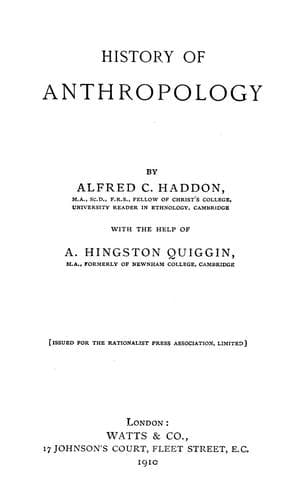
History of anthropologyHaddon, Alfred C. (Alfred Cort)
History
History of anthropology
Haddon, Alfred C. (Alfred Cort)
Anthropology -- History
In the department of experimental psychology Germany again took the
lead. G. T. Fechner[63] attempted by means of laboratory tests to
discover the law of connection between psychical and bodily events. A
band of workers arose, and the new science spread to other countries. In
our country Sir Francis Galton took advantage of the International
Health Exhibition at London, 1884, to install in the exhibition an
anthropometric laboratory, in which a few psychological experiments were
made on a large number of people, and since then he has frequently made
arrangements for similar laboratories.
Footnote 63:
_Elemente der Psychophysik_, 1860.
In nearly all of the larger universities Experimental Psychology is a
recognised study, and almost every variety of mental condition is
investigated. Professor W. Wundt, in his _Völkerpsychologie_ (1904), has
been a master-builder on these foundations.
The experiments in psychological laboratories were of necessity confined
to subjects readily accessible, who naturally were mainly Europeans or
of European descent. A few observations had been made on aliens who, as
a rule, had been brought from their native countries for show purposes;
but in these cases the observations were made under unfavourable
conditions so far as the subject was concerned. With the exception of
these very few and unsatisfactory investigations, experimental
psychology was mainly concerned with the subjects numbered 2, 3, and 5
in the table on p. 81.
A new departure was made in 1898 by the Cambridge Anthropological
Expedition to Torres Straits. For the first time trained experimental
psychologists (Drs. W. H. R. Rivers, W. McDougall, and C. S. Myers)
investigated by means of an adequate laboratory equipment a people in a
low stage of culture under their ordinary conditions of life. The
foundations of ethnical experimental psychology were thus laid.
Professor R. W. Woodworth sums up the conclusions arrived at from his
own observations and those of others as follows: “We are probably
justified in inferring that the sensory and motor processes and the
elementary brain activities, though differing in degree from one
individual to another, are about the same from one race to another.”[64]
Footnote 64:
_Science_, xxxi., 1910, p. 179.
Lately an attempt has been made, under the auspices of the Royal
Anthropological Institute, to provide travellers with instructions for
psychological investigations in the field.
[Sidenote: =Eugenics.=]
Public-domain text, read in full here on John Shaqi.
Reviews
Reviews
No reviews yet
Be the first to share your thoughts on this work.
Elsewhere in the archive
Join the Discussion
Join the discussion
Sign in to leave a comment or review.
Sign InorCreate an account