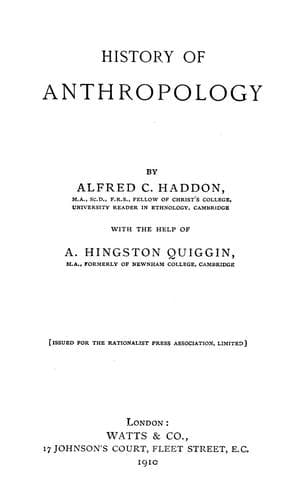
History of anthropologyHaddon, Alfred C. (Alfred Cort)
History
History of anthropology
Haddon, Alfred C. (Alfred Cort)
Anthropology -- History
Blumenbach was the originator of the unfortunate title “Caucasian”[67]
to represent the typical European and the inhabitants of Eastern Asia
and Northern Africa. He chose the name partly because the Caucasus
produces the most beautiful race of men, and also on account of the fine
Georgian skull in his collection.[68] It was unfortunate, since, as
Ripley points out (1900, p. 436), nowhere else in Europe is found such a
heterogeneity of physical types—the only one conspicuously missing being
the fair-haired, blue-eyed European—and such a diversity of language,
sixty-eight dialects being here jumbled together, and only one possessed
of (possibly) Aryan origin. The name “Caucasian” has, therefore, not led
to clarification of ideas in the complex problem of European ethnology.
Keane (1899), however, supports its use, saying: “Those who object to
Caucasic are apt to forget the vast field that has to be embraced by
this single collective term.” “Caucasic, when properly understood ...
cannot be dispensed with until a more suitable general term be
discovered” (p. 447).
Footnote 67:
_Anthrop. Treatises of Blumenbach_, translated by T. Bendyshe, 1865,
pp. 265, 269.
Footnote 68:
Waitz, 1863, p. 233, _f.n._, who adds: “without any intention on his
part to express thereby an opinion as to the cradle of these peoples.”
Keane, 1896, p. 226.
[Sidenote: =Other Classifications.=]
The next important classification was that of Cuvier, who derived
mankind from the three sons of Noah, Japhet being regarded as the parent
of the Caucasic, Shem of the Mongolian, and Ham of the African races.
The divergence of type between the three brothers is not explained,
except that the blackness of the descendants of Ham was attributed to
the curse imposed by Noah on Canaan, the son of Ham (Gen. ix. 25).
Other classifications followed, the divisions varying from two species,
white and black, Virey (1801), to the fifteen or sixteen of the
Polygenists, Desmoulins (1825-6), and Bory de Saint-Vincent (1827), and
the thirty-four of Haeckel (1873).
In America L. Agassiz, an uncompromising opponent of evolution,
asserted, in 1845,[69] the unity of mankind as a species; but in
1850[70] we find him distribute eleven or twelve, in 1853 (in Nott and
Gliddon) eight, human species in as many geological and botanical
provinces. But this theory had been previously promulgated by Desmoulins
(1826) and by Swainson (in 1835).[71] As Waitz rightly says: “They are
completely in error who, adopting the views of Agassiz, assume as many
original types of mankind as there are typically different peoples on
the globe” (1864, p. 203).
Footnote 69:
Smith, 1850, _Unity of the Human Races_, p. 349.
Footnote 70:
_Christian Examiner_, Boston, July, 1850.
Footnote 71:
_Treatise on the Geography and Classification of Animals._
Public-domain text, read in full here on John Shaqi.
Reviews
Reviews
No reviews yet
Be the first to share your thoughts on this work.
Elsewhere in the archive
Join the Discussion
Join the discussion
Sign in to leave a comment or review.
Sign InorCreate an account