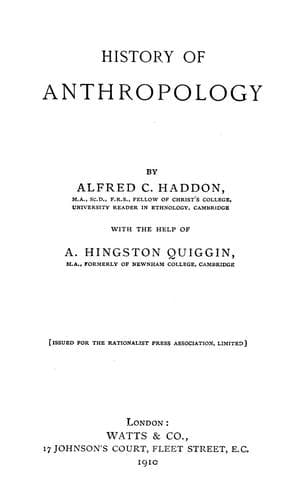
History of anthropologyHaddon, Alfred C. (Alfred Cort)
History
History of anthropology
Haddon, Alfred C. (Alfred Cort)
Anthropology -- History
Tylor (1871) insisted on the necessity of sifting and testing all the
evidence, relying to a great extent on “the test of recurrence,” or of
undesigned coincidence in testimony; he says: “the more odd the
statement, the less likely that several people in several places should
have made it wrongly. This being so, it seems reasonable to judge that
the statements are in the main truly given, and that their close and
regular coincidence is due to the cropping-up of similar facts in
various districts of culture. Now the most important facts of
ethnography are vouched for in this way” (2nd ed., 1873, p. 10).
[Sidenote: =Avebury.=]
A further stimulus to the study of comparative ethnology in this country
was given by the publication of Sir John Lubbock’s (Lord Avebury’s)
_Origin of Civilisation_ (1870), and opened the eyes of a large public
to the interest of ethnology and its value in throwing light upon the
earlier stages of culture of civilised peoples.
[Sidenote: =Sociology.=]
The question as to the influence of environment on the development of
social organisation is as old as the world’s oldest thinkers, and finds
expression in Aristotle and in Plato, though Sociology, as a science, is
a product of the last century. The word “Sociology” was first used by
Auguste Comte (1798-1857), who showed its aim to be to discover the
nature, the natural causes, and the natural laws of society. With the
development of natural science came the insistence on a naturalistic
interpretation of social differences, demonstrated by Guyot (1807-1884)
and Draper (1811-1882), and over-emphasised by Buckle (1821-1862).
[Sidenote: =Comte Buckle.=]
Comte’s method was that of deductive construction and prescription.
Buckle’s plan was to evolve a social science inductively through a study
of history, with the help of economics and statistics. His _History of
Civilisation_ answers the great question which he sets himself: “Are the
actions of men, and therefore of societies, governed by fixed laws, or
are they the result either of chance or of supernatural interference?”
He attempted to show how “Climate, Food, Soil, and the General Aspect of
Nature” were the dominant influences in early societies, determining the
food supply, the degree of population, and the economic condition.
Unfortunately, in pursuit of this idea Buckle was apt to overlook the
influences of culture-contact, and of economic factors; thus deserving,
to some extent, the censure of Jevons: “Buckle referred the character of
a nation to the climate and the soil of its abode.”[101] At the same
time Buckle must be regarded as the first historical sociologist of the
modern scientific movement.
Footnote 101:
_Letters and Journal of Stanley Jevons_, 1866, p. 454.
[Sidenote: =Herbert Spencer.=]
Public-domain text, read in full here on John Shaqi.
Reviews
Reviews
No reviews yet
Be the first to share your thoughts on this work.
Elsewhere in the archive
Join the Discussion
Join the discussion
Sign in to leave a comment or review.
Sign InorCreate an account