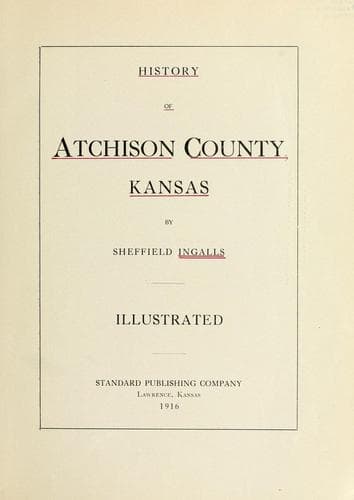
History of Atchison County, KansasIngalls, Sheffield
History
History of Atchison County, Kansas
Ingalls, Sheffield
Atchison County (Kan.) -- Biography; Atchison County (Kan.) -- History
But while his company was the first organized, it happened that
Dickerson’s commission as captain was the second issued, and was signed
by Governor Charles Robinson, before the State had an official seal.
Afterwards, Mr. Dickerson served in the regular volunteer service, as
first lieutenant.
He lived on his land, north of town, for many years, and died in
Atchison on the thirteenth day of December, 1910.
LUTHER C. CHALLISS.
Luther C. Challiss came to Atchison in 1855 from Boonville, Mo., where
he was engaged as a merchant. He remained here continuously until 1861
as merchant, banker, ferry operator and real estate owner. Luther C.
Challiss’ addition, the east line of which is at the alley between
Seventh and Eighth streets, was preëmpted by Mr. Challiss in 1857, and
was originally composed of 198 acres.
As a member of the Territorial council, Mr. Challiss secured the first
charter for a railroad west from Atchison, known as the Atchison Pike’s
Peak railroad, now the Central Branch. He was the first president of the
road, and originally owned every dollar of the stock. He also managed
the Kickapoo treaty, which gave the road 150,000 acres of land, and made
it prominent in Washington as a specific possibility. The original
Government subsidy for this road was every other quarter section of land
for ten miles on either side, in addition to $16,000 to $48,000 per
mile, in Government bonds.
At the same time Mr. Challiss secured a charter for the Atchison-Pike’s
Peak railroad, he secured a charter for the Atchison, Topeka & Santa Fe
railroad, his original idea being a southern route to the Pacific, and
that road has fulfilled all of his early expectations.
Mr. Challiss made a great deal of money in Atchison, and in 1864 drifted
to New York and Washington, where he became an operator on the stock
exchange. Mr. Challiss’ sympathies were with the South, and was
generally a bull. As long as the South showed its ability to hold out
Mr. Challiss made a great deal of money, and at one time he had on
deposit in New York $960,000, but the tide turned against him when the
South began to fail, and this fortune was reduced to nothing.
Public-domain text, read in full here on John Shaqi.
Reviews
Reviews
No reviews yet
Be the first to share your thoughts on this work.
Elsewhere in the archive
Join the Discussion
Join the discussion
Sign in to leave a comment or review.
Sign InorCreate an account